

How to Start Bitcoin Mining at Home in 2026 (Beginner's Guide)
How to Start Bitcoin Mining at Home in 2026 (Beginner's Guide)
Most home miners in Europe are losing money right now — not because mining is dead, but because they bought the wrong machine at the wrong electricity rate. After the April 2024 halving cut the block reward to 3.125 BTC, margins got tighter, and the gap between a well-chosen setup and a badly-chosen one widened considerably. That gap is now measured in hundreds of euros per month.
The network hashrate is sitting somewhere between 800 and 1,000 EH/s as of Q1 2026 (Source: mempool.space, Q1 2026). Mining difficulty has climbed to around 110–120 trillion. Bitcoin is trading near $85,000 USD. None of this makes home mining impossible — but it does mean the miner you choose and the electricity rate you pay are the only two variables that actually matter. Everything else is noise.
This guide is for European beginners who want honest numbers, not a sales pitch. We will talk about which hardware makes sense, what your electricity bill will actually do to your margins, and what most guides conveniently forget to mention.
What We Cover
- What bitcoin mining at home actually is — and what it costs
- Why electricity rate is the only number that matters
- Choosing the right hardware for a home setup
- Hardware comparison: which miners make sense in 2026
- Getting started: pools, wallets, and setup basics
- Frequently Asked Questions
- What you can actually expect from home mining in 2026
What Bitcoin Mining at Home Actually Is — and What It Costs
Bitcoin mining at home is the process of running a specialised ASIC (Application-Specific Integrated Circuit) machine that performs SHA-256 hashing computations, competing with the global network to validate transactions and earn a share of the current 3.125 BTC block reward — with the network producing approximately 144 blocks per day.
That definition matters because it contains the stakes. You are not downloading software on your laptop. You are running dedicated hardware that draws between 400W and 3,500W continuously, 24 hours a day. A mid-range home miner pulling 1,200W costs roughly €52–€86 per month in electricity depending on whether you are in France at €0.22/kWh or Denmark at €0.36/kWh (Eurostat, Q4 2025). That cost runs whether or not you mine a single satoshi.
Most mining guides skip the cost side entirely, which is maddening. They show you hashrate charts and ROI calculators but never say: at €0.28/kWh — which is what a typical German household pays — a lot of older-generation machines are running at a loss right now. Full stop.
Why Electricity Rate Is the Only Number That Matters
Say you live in Latvia and pay €0.18/kWh. That is one of the better residential rates in the EU and changes the maths dramatically compared to someone in Germany paying €0.28/kWh or the Netherlands at €0.25/kWh. The hardware is the same. The Bitcoin reward is the same. But one setup is profitable and the other is not.
Efficiency — measured in joules per terahash (J/TH) — is how you translate electricity cost into real money. A machine running at 20 J/TH is twice as expensive to operate as one running at 10 J/TH, for the same hashrate output. That difference, at scale, is significant. We are talking €60–€120 per month per machine — money that either goes into your pocket or your electricity provider's.
Here is the counterintuitive advice most articles miss: for European home miners, a lower-hashrate machine with excellent efficiency often beats a high-hashrate machine with mediocre efficiency. A loud 3,500W beast that produces 300 TH/s at 11.7 J/TH might look impressive, but if your home circuit cannot handle the load, your landlord notices, or your neighbours complain about the noise — and they will — it is not a practical home setup. Smaller, quieter, more efficient machines built for residential use exist precisely for this reason.
The mini Bitcoin miners category is worth serious attention if you are starting out. These machines are designed to run in a home environment — quieter fans, lower power draw, no industrial three-phase requirements.
Choosing the Right Hardware for a Home Setup
Noise and Heat — the Two Problems Nobody Warns You About
A standard Antminer or Whatsminer running at full load sounds like a vacuum cleaner that never stops. Not great if you live in a flat, have a sleeping child nearby, or simply want to retain your sanity. Honestly, this alone eliminates most industrial-grade miners from the home conversation.
Heat is the second problem. A 3,000W miner exhausts roughly the equivalent of three electric heaters running simultaneously. In winter, that is free heating. In summer, it is a problem that requires ventilation you probably have not planned for.
What to Actually Look For
- Power draw under 1,500W for most home setups on a standard 16A circuit
- Efficiency of 15 J/TH or better — anything above 25 J/TH is difficult to justify at EU electricity rates
- Fan noise rated below 65dB if the machine is anywhere near living space
- Single-phase 220–240V compatibility — standard across EU households
- A machine that Mineshop.eu actually stocks and can deliver within a week via DHL or FedEx, so you are not waiting two months for hardware from a grey-market reseller
In our experience shipping to customers across 27 EU countries, the biggest mistake beginners make is buying the highest-hashrate machine they can find without checking whether it is physically suitable for their home — then discovering three weeks later that their fuse box trips every time it spins up, or that their flatmates have issued an ultimatum.
Hardware Comparison: Which Miners Make Sense in 2026
| Miner | Algorithm | Hashrate | Power Draw | Efficiency | Home-Friendly? |
|---|---|---|---|---|---|
| Goldshell AE Box Pro | Aleo (AleoBFT) | 44 MH/s | ~350W | ~8 W/MH | ✅ Yes — quiet, low draw |
| Bitmain Antminer X9 | RandomX (XMR) | High-efficiency XMR | ~1,200W | Strong for RandomX | ⚠️ Moderate — manageable noise |
| Bitmain Antminer S23 Hyd | SHA-256 (BTC) | High SHA-256 | ~3,000W+ | Excellent (hydro-cooled) | ⚠️ Requires water cooling setup |
| Pinecone INIBOX | INI | Compact home spec | Low draw | Good for home use | ✅ Yes — designed for home |
The home miner category at Mineshop filters specifically for machines that work in residential environments. Worth starting there rather than browsing the full industrial catalogue and guessing.
Getting Started: Pools, Wallets, and Setup Basics
Mining Pools vs. Solo Mining
Solo mining Bitcoin at home in 2026 is — let's be honest — a lottery ticket. With the network at 800–1,000 EH/s, a single home miner's probability of finding a block independently is statistically negligible. You can check exact odds for your hashrate at soloblocks.io/calculator. The numbers are sobering.
Join a pool. Full stop. Pools aggregate hashrate from thousands of miners, find blocks regularly, and distribute rewards proportionally. Braiins Pool, Foundry USA Pool, and ViaBTC all accept EU miners. Fees typically run 1–2% of earnings — a reasonable cost for predictable payouts.
Wallet Setup
You need a Bitcoin wallet address before you mine a single satoshi. Hardware wallets (Ledger, Trezor) are the most secure option for long-term storage. For pool payouts, a software wallet works fine. Never mine directly to an exchange — if the exchange freezes withdrawals, your earnings are inaccessible.
The Physical Setup
Connect the miner to your router via ethernet — not Wi-Fi, ever. Access the miner's web interface via its local IP address, enter your pool credentials and wallet address, and it starts hashing within minutes. The actual configuration is straightforward for anyone comfortable with a home router setup.
Mineshop.eu has been supplying European miners with genuine ASIC hardware since 2016, with EU warehouse stock in Ireland and fast DHL/FedEx delivery across all EU countries.
Frequently Asked Questions
Is bitcoin mining at home profitable in Europe in 2026?
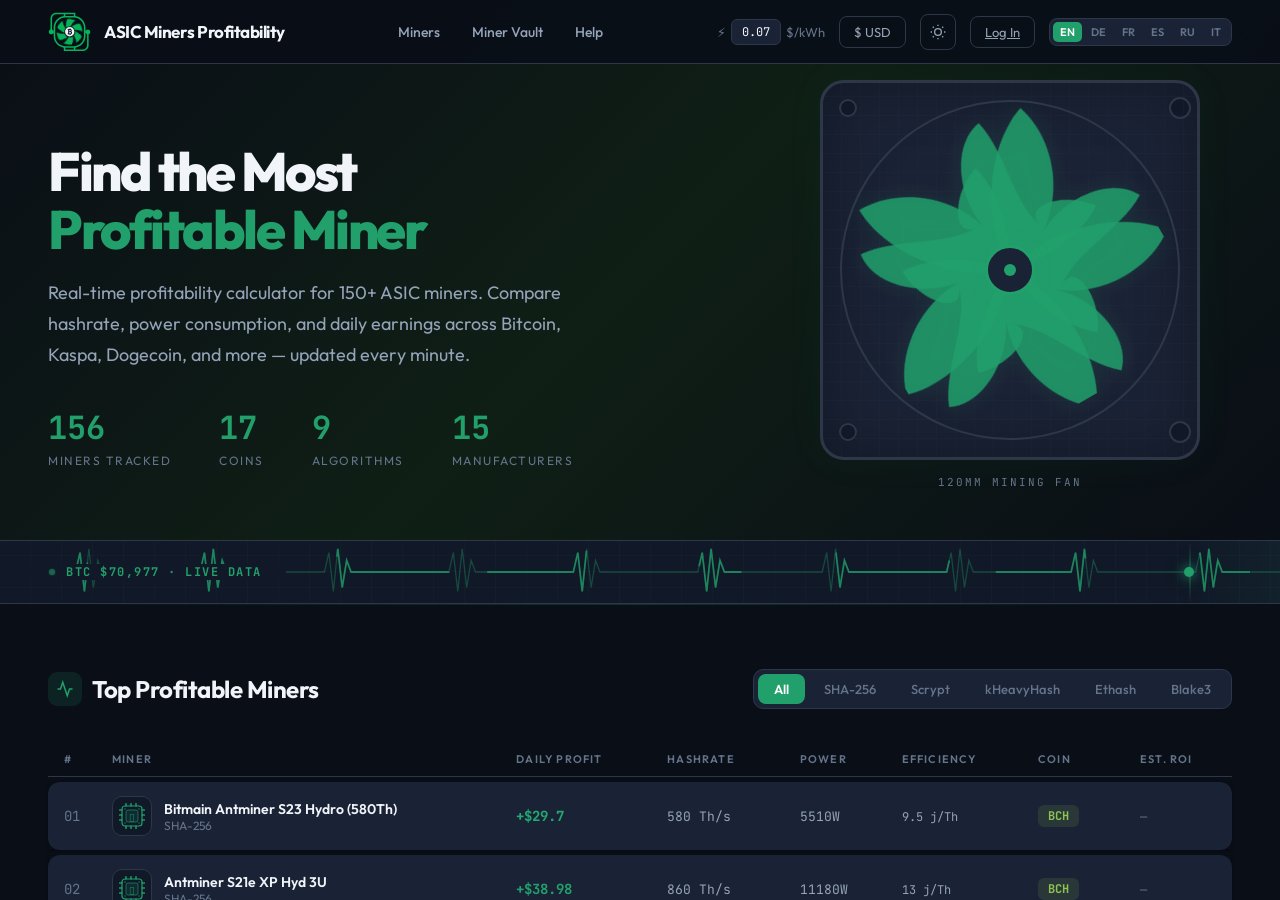
A: It depends almost entirely on your electricity rate. At €0.18–0.20/kWh with an efficient modern machine, home mining can generate a modest positive return. At €0.28/kWh or above — common in Germany, Denmark, and Belgium — margins are thin to negative for most SHA-256 miners. Alternative algorithm miners (RandomX, Aleo) can offer better margins at higher electricity rates. Always run your numbers at asicminersprofitability.com before purchasing hardware.
What is the minimum budget to start bitcoin mining at home?
A: A genuine entry-level home mining setup starts around €300–€600 for a compact, low-power machine. Industrial SHA-256 miners cost €1,500–€8,000+. Factor in a power strip with surge protection (€30–€60) and proper ventilation if needed. Avoid used miners from unknown sellers — degraded hash boards are a common and expensive problem.
How loud are home bitcoin miners?
A: Industrial ASIC miners typically run at 70–80dB — comparable to a vacuum cleaner running continuously. This is not acceptable in most home living spaces. Machines specifically designed for home use, such as those in the mini miners category, run at 40–55dB, which is manageable in a garage, utility room, or dedicated office space.
Do I need special electrical wiring for a home miner?
A: Standard EU 220–240V single-phase outlets handle most home-grade miners drawing up to 1,500–1,800W. A dedicated 16A circuit is advisable to avoid tripping your breaker. Machines above 2,500W may require a 32A circuit or three-phase power — not typical in residential properties. Check the miner's power specifications before purchasing.
What happens to my mining earnings after the halving?
A: The April 2024 halving reduced the block reward from 6.25 BTC to 3.125 BTC. This means each block found pays out half as much as before. Mining earnings are partially offset by higher Bitcoin prices post-halving — historically, prices have risen enough over 12–18 months to compensate. The next halving is expected around 2028, cutting the reward to approximately 1.5625 BTC.
Can I mine Bitcoin with a GPU at home instead of an ASIC?
A: No. GPU mining Bitcoin is economically pointless in 2026. The network hashrate is 800–1,000 EH/s, almost entirely composed of purpose-built ASIC machines. A high-end GPU produces roughly 0.1 GH/s on SHA-256. A mid-range ASIC produces 100,000+ GH/s (100 TH/s). The difference is six orders of magnitude. GPUs are still viable for certain altcoin algorithms, but not Bitcoin.
What You Can Actually Expect from Home Mining in 2026
Bitcoin mining at home in 2026 is not passive income. It is a business with real operating costs, real hardware decisions, and real exposure to Bitcoin price swings. For a European miner paying €0.20/kWh with a well-chosen, efficient machine, it can generate a meaningful return over a 12–18 month horizon. At €0.28/kWh with an older or inefficient machine, it is an expensive hobby at best.
The honest answer is: run your numbers before you buy anything. Know your electricity rate. Know the machine's power draw. Know the current difficulty. Then decide. Anyone selling you a miner without walking you through that calculation is not doing you a favour.
The miners that actually make sense for home use in 2026 are the ones designed for it — low noise, manageable power draw, real efficiency ratings. Browse the full ASIC miner range at Mineshop.eu, filter by what your home setup can actually support, and start there. If you are unsure, the Mineshop team is reachable directly — and they will give you a straight answer rather than pushing whatever has the highest margin that week.
Related Blog
Mining Bitcoin in an Apartment: Is It Possible?
Mar 26, 2026 by Guntis Vitolins
Mineshop
Solo Mining vs Pool Mining: Vilket är bäst för hemmautvinnar?
Mar 21, 2026 by Guntis Vitolins
Mineshop
Solo Mining vs Pool Mining: ¿Cuál es mejor para los mineros domésticos?
Mar 21, 2026 by Guntis Vitolins
Mineshop
Solo Mining vs Pool Mining : Lequel est le meilleur pour les mineurs à domicile ?
Mar 21, 2026 by Guntis Vitolins
Mineshop