


Comment Construire une Ferme de Minage Bitcoin en 2026 : Guide Complet
Alors que le paysage du minage Bitcoin continue d'évoluer, de nombreux mineurs intermédiaires envisagent de faire évoluer leurs opérations de quelques ASICs vers une petite ferme de minage. Si vous souhaitez construire une ferme de minage en 2026, ce guide vous fournira des étapes pratiques pour mettre en place une opération rentable, tout en tenant compte des réalités des coûts d'électricité européens et des conditions du marché.
Choix du Site
La première étape dans la construction d'une ferme de minage Bitcoin est de choisir le bon emplacement. Votre site doit trouver un équilibre entre accessibilité, sécurité et, surtout, coûts d'électricité. Étant donné que les prix de l'électricité en Europe peuvent varier de €0,20 à €0,30 par kWh, il est crucial de trouver un emplacement avec les tarifs les plus bas possibles. Par exemple, les régions de Scandinavie, comme la Norvège et la Suède, offrent souvent des tarifs aussi bas que €0,05 à €0,10 par kWh grâce à l'abondance de l'énergie hydroélectrique.
Recherchez des zones disposant de sources d'énergie renouvelables abondantes, telles que l'hydroélectricité ou l'énergie éolienne, car elles peuvent souvent fournir une électricité moins chère. De plus, tenez compte de la proximité d'une connexion internet, car une connexion stable et rapide est essentielle pour les opérations de minage. La fibre optique est préférable, avec des vitesses d'au moins 100 Mbps. Enfin, assurez-vous que le site est protégé contre le vol et le vandalisme, ce qui peut être une préoccupation pour du matériel de minage de valeur. Investir dans des systèmes de sécurité, tels que des caméras et des alarmes, peut aider à protéger votre investissement.
Infrastructure Électrique
Une fois que vous avez choisi un site, vous devrez mettre en place une infrastructure électrique solide. Calculez la consommation électrique totale de vos rigs de minage pour déterminer la capacité électrique requise. Chaque Bitmain Antminer S21, par exemple, consomme environ 3250W, donc si vous prévoyez d'exploiter 10 unités, vous aurez besoin d'une alimentation capable de gérer environ 32,5 kW. Il est également judicieux de prévoir une marge de sécurité d'environ 20 % pour s'assurer que votre système peut gérer les fluctuations.
Consultez un électricien agréé pour vous assurer que votre installation électrique peut supporter la charge, et envisagez d'installer des circuits dédiés pour votre équipement de minage. Vous pourriez également souhaiter explorer des options de solutions d'alimentation de secours, telles que des générateurs ou des systèmes UPS, pour minimiser les temps d'arrêt lors des pannes. Un UPS d'une capacité d'au moins 10 kVA peut fournir une alimentation de secours suffisante pour votre opération lors de courtes pannes, garantissant un minage continu et prévenant les dommages matériels.
Sélection du Matériel
Choisir le bon matériel est crucial pour l'efficacité et la rentabilité de votre ferme de minage. Les mineurs ASIC sont la norme pour le minage Bitcoin, et en 2026, des options comme le Bitmain Antminer S21 et le Whatsminer M60S sont des choix populaires parmi les mineurs. L'Antminer S21 offre un hashrate d'environ 140 TH/s avec une consommation électrique de 3250W, tandis que le Whatsminer M60S fournit environ 110 TH/s à 3300W. Évaluez leurs hashrates, leur consommation électrique et leur prix pour trouver la meilleure adéquation à votre opération.
Lors du passage de 1 à 2 unités à une petite ferme de 5 à 20 ASICs, considérez l'équilibre entre l'investissement initial et les rendements potentiels. Par exemple, si vous achetez 10 Antminer S21 à €5 000 chacun, votre investissement initial serait de €50 000. Avec un prix actuel du Bitcoin de €30 000 et une difficulté de minage moyenne, vos revenus mensuels pourraient être d'environ €4 500, mais cela peut fluctuer significativement en fonction des conditions du marché. Il peut être bénéfique de commencer avec un nombre plus restreint d'unités et d'augmenter progressivement à mesure que vous vous familiarisez avec les défis opérationnels et la dynamique du marché.
Refroidissement
Le refroidissement est un aspect critique de toute opération de minage, surtout lorsque vous montez en puissance. Les mineurs ASIC génèrent une quantité significative de chaleur, ce qui peut affecter les performances et réduire la durée de vie de votre équipement. Investissez dans un système de refroidissement approprié qui comprend une ventilation adéquate, la climatisation, ou même le refroidissement par immersion si votre budget le permet. Un système de refroidissement bien conçu peut réduire les températures jusqu'à 20 degrés Celsius, améliorant ainsi l'efficacité et la longévité.
Explorez des options comme les conteneurs de minage qui sont pré-équipés de solutions de refroidissement. Ces conteneurs peuvent être placés à l'extérieur ou dans une zone désignée pour gérer efficacement la chaleur tout en offrant également sécurité et réduction de la pollution sonore. Si vous optez pour la climatisation, calculez les besoins en BTU en fonction de la production de chaleur totale de vos mineurs. Par exemple, si chaque mineur génère environ 3 500 BTUs, un système de refroidissement d'une capacité de 30 000 BTUs serait adéquat pour 10 mineurs.
Configuration Réseau
Une connexion internet stable et sécurisée est essentielle pour votre ferme de minage. Assurez-vous de disposer d'une connexion haut débit fiable avec une bande passante suffisante pour gérer plusieurs mineurs simultanément. Une connexion Ethernet filaire est préférable au Wi-Fi pour minimiser la latence et les problèmes de connectivité. Visez une vitesse de connexion d'au moins 100 Mbps pour assurer un fonctionnement fluide.
Envisagez de mettre en place un routeur dédié et un commutateur réseau pour gérer efficacement vos appareils de minage. Recherchez des routeurs de grade industriel capables de gérer des charges élevées et d'offrir des fonctionnalités de sécurité renforcées. Utilisez un VPN pour une sécurité accrue et pour protéger votre opération de minage contre les cybermenaces potentielles. Mettez régulièrement à jour vos appareils réseau et utilisez des pare-feux pour vous protéger contre les accès non autorisés.
Surveillance
La surveillance de votre opération de minage est essentielle pour optimiser les performances et minimiser les temps d'arrêt. Utilisez des logiciels capables de suivre les performances de chaque mineur ASIC, notamment les hashrates, les températures et la consommation électrique. Ces données vous aideront à identifier les problèmes rapidement et à prendre des décisions éclairées concernant la maintenance ou les mises à niveau du matériel. Les solutions logicielles populaires incluent Awesome Miner et Minerstat, qui peuvent fournir des analyses détaillées et des alertes.
Diverses solutions de surveillance sont disponibles, allant de simples tableaux de bord à des configurations sophistiquées pouvant envoyer des alertes directement sur votre téléphone ou par e-mail. Choisissez un système adapté à vos besoins et à votre budget, et assurez-vous qu'il peut évoluer à mesure que vous ajoutez des unités à votre ferme. Par exemple, définir des seuils pour les baisses de hashrate ou les pics de température peut vous aider à prendre des mesures proactives avant que les problèmes ne s'aggravent.
Vérification de la Rentabilité
Avant de vous lancer tête baissée dans la construction de votre ferme de minage, il est crucial de réaliser une analyse de rentabilité. Utilisez des outils comme ce calculateur de rentabilité pour évaluer vos retours potentiels en fonction des prix actuels du Bitcoin, de la difficulté de minage et de vos coûts d'électricité spécifiques. Saisissez des variables telles que le hashrate de votre matériel, le prix de l'électricité et les frais de pool pour obtenir une image claire de vos gains potentiels.
N'oubliez pas que le paysage du minage peut être volatile, et la rentabilité peut fluctuer en fonction de divers facteurs, notamment les conditions du marché, les tarifs d'électricité et l'efficacité du matériel. Assurez-vous d'avoir une compréhension claire de vos coûts d'exploitation et de vos revenus potentiels avant de consacrer des ressources significatives à votre ferme de minage. Envisagez de créer un modèle financier incluant des scénarios défavorables pour vous préparer aux baisses du marché.
En résumé, construire une ferme de minage Bitcoin en 2026 nécessite une planification et une exécution soigneuses. Concentrez-vous sur le choix du site, l'infrastructure électrique, le choix du matériel, les solutions de refroidissement, la configuration réseau et une surveillance efficace pour vous positionner en vue du succès. En suivant ces étapes et en restant réaliste quant à la rentabilité, vous pouvez faire évoluer votre opération de minage efficacement.
Questions Fréquemment Posées
Combien coûte la construction d'une petite ferme de minage Bitcoin en 2026 ?
R : Une petite ferme de 10 unités Antminer S21+ (216 TH/s chacune) coûte approximativement : mineurs €35 000–40 000 + PDUs/rack €2 000–3 000 + installation électrique €3 000–8 000 + infrastructure de refroidissement €2 000–5 000 = €42 000–56 000 de coût total d'installation. Coût d'exploitation mensuel à €0,10/kWh : ~€2 400 en électricité. Revenus bruts mensuels à BTC €80 000 : ~€7 000–9 000. (Source : tarification Mineshop.eu, T1 2026 ; asicminersprofitability.com.)
Quelle quantité d'électricité consomme une ferme de minage Bitcoin ?
R : Chaque Antminer S21+ consomme 3 360W. Une ferme de 10 unités consomme 33,6 kW en continu — nécessitant une alimentation triphasée dédiée de 63A dans la plupart des locaux commerciaux européens. Consommation mensuelle : environ 24 192 kWh. Une ferme de 100 unités consomme ~336 kW et utilise ~242 000 kWh/mois. Cela nécessite généralement un transformateur dédié et une connexion directe au réseau électrique. Confirmez toujours la capacité de votre connexion au réseau avant d'acheter du matériel.
Quel système de refroidissement faut-il pour une ferme de minage Bitcoin ?
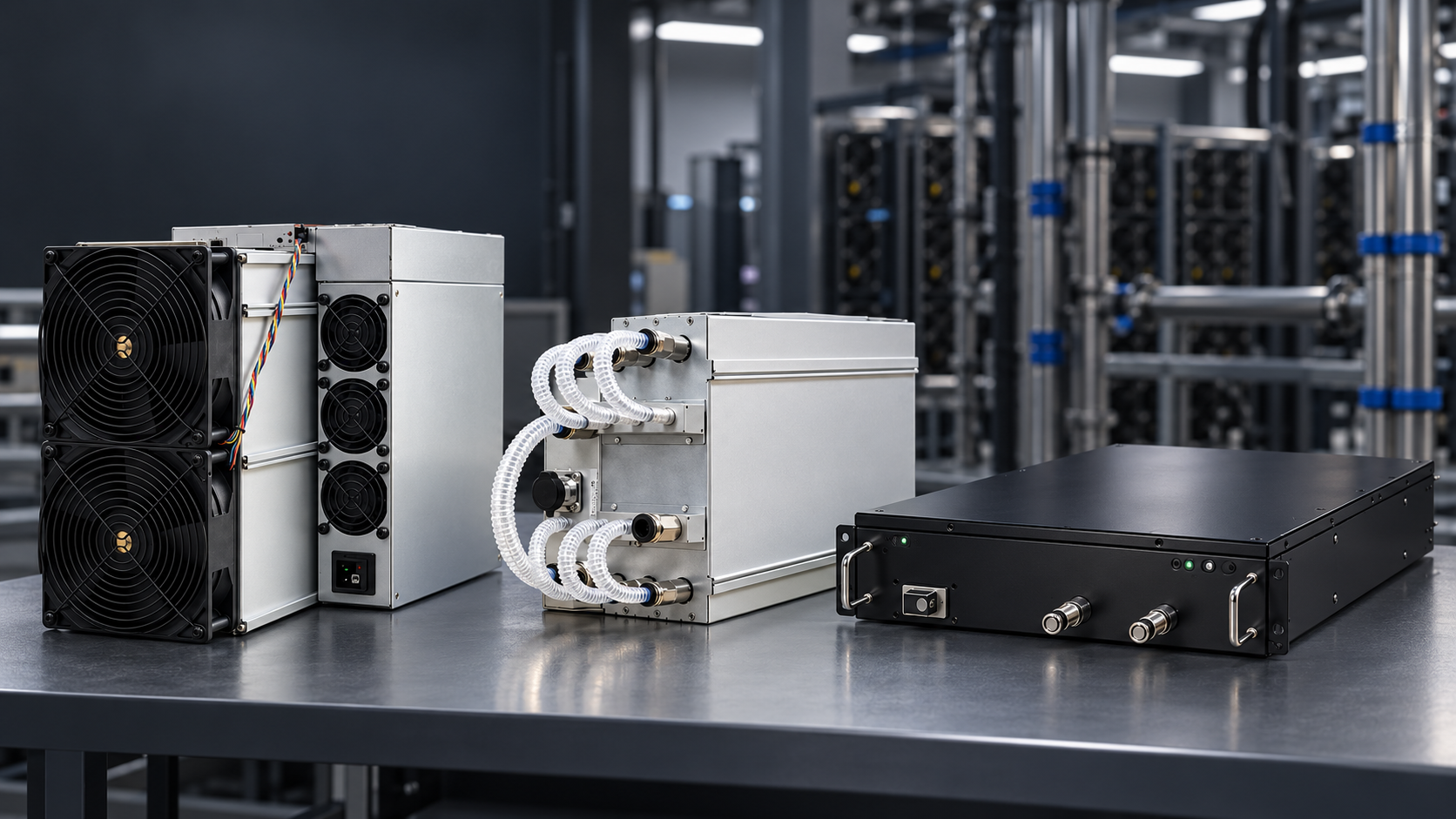
R : Trois options principales en 2026 : (1) Refroidissement par air — entrée/sortie d'air standard avec ventilateurs industriels, le moins cher à l'achat (€200–500/unité), nécessite 3 à 5 renouvellements d'air par heure dans la salle de minage. (2) Refroidissement par immersion — immersion des mineurs dans un fluide diélectrique, 40 % plus efficace, coût d'installation €800–2 000/unité, permet des overclocks plus élevés. (3) Refroidissement hydraulique — refroidissement par eau en circuit fermé intégré dans certains mineurs spécifiques (ex. Whatsminer M63S). Pour les fermes de moins de 20 unités, le refroidissement par air est le point de départ pratique.
Faut-il un permis pour exploiter une ferme de minage Bitcoin en Europe ?
R : Les exigences varient selon les pays et l'échelle. Dans la plupart des pays de l'UE : les petites installations domestiques (moins de 10 kW) ne nécessitent généralement aucun permis au-delà des travaux électriques standard. Les fermes commerciales (10–100 kW) peuvent nécessiter un zonage industriel/commercial, des permis de dérogation au bruit (les mineurs dépassent 75 dB) et des mises à niveau du réseau électrique. Vérifiez toujours les règles de votre municipalité locale et consultez un électricien agréé pour la connexion au réseau. La classification en tant que centre de données peut s'appliquer au-delà de certains seuils.
Quel est le délai de ROI réaliste pour une petite ferme de minage Bitcoin en 2026 ?
R : À €0,08/kWh et BTC €80 000, une ferme de 10× S21+ (2 160 TH/s au total) rapporte environ €180–220/jour brut, ~€115–155/jour net. Coût total d'installation ~€50 000 → seuil de rentabilité atteint en environ 12 à 18 mois. À €0,15/kWh, le seuil de rentabilité s'étend à 24–36 mois. Risque principal : la volatilité du prix du BTC. Une baisse de 50 % du prix du BTC double la période de remboursement. Utilisez asicminersprofitability.com pour modéliser les scénarios actuels.
Où acheter des mineurs ASIC en gros pour une ferme de minage en Europe ?
R : Mineshop.eu fournit des commandes de mineurs ASIC en gros aux fermes européennes, avec de véritables garanties fabricant et la livraison par fret DHL/FedEx. La plupart des commandes sont expédiées depuis l'Irlande et la Lettonie. Mineshop est le fournisseur de matériel ASIC de confiance de l'UE depuis 2016. Contactez notre équipe commerciale pour des tarifs dégressifs à partir de 5 unités.