

What Is Mining Hashrate and Why Does It Matter?
What Is Mining Hashrate and Why Does It Matter?
Most home miners in Europe are losing money right now — not because mining is dead, but because they bought the wrong machine at the wrong electricity rate and never understood what hashrate actually costs them per month. Hashrate sounds like a bragging number. It is not. It is a cost-per-unit-of-work figure that determines whether you are building Bitcoin or burning euros.
Here is the part most mining guides skip entirely, which is maddening: raw hashrate without efficiency context is meaningless. A miner doing 200 TH/s sounds impressive until you learn it draws 5,000 watts and runs your German electricity bill up by €360 a month. Meanwhile a machine doing 140 TH/s at 1,850 watts costs you €130 a month to run. Same pool. Same Bitcoin price. Wildly different outcomes.
So let us talk about what hashrate actually is, why the number on the box is only half the story, and what European miners specifically need to understand before they plug anything in.
What We Cover
- What hashrate is — and what it measures
- Why efficiency (J/TH) matters more than raw hashrate
- Network hashrate, difficulty, and your actual odds
- How three real miners compare at European electricity rates
- What European home miners should actually do with this information
- Frequently Asked Questions
What Hashrate Is — and What It Measures
Mining hashrate is the number of SHA-256 hash computations a mining device performs per second, where each computation is an attempt to find the valid block header that satisfies Bitcoin's current difficulty target. One terahash per second (TH/s) means one trillion attempts per second.
Bitcoin's network currently sits at roughly 800–1,000 exahashes per second (EH/s) as of Q1 2026 (Source: mempool.space, Q1 2026). That is 800,000,000,000,000,000,000 hash attempts every second, collectively, across every miner on the planet. Your single ASIC doing 200 TH/s represents about 0.00000002% of that. Which sounds discouraging. But it is proportional — your share of block rewards matches your share of hashrate, at least in a pool.
The unit ladder goes: KH/s → MH/s → GH/s → TH/s → PH/s → EH/s. Home ASICs today operate in the TH/s range. Industrial operations measure in PH/s. The entire Bitcoin network is now measured in EH/s. Worth knowing before you buy: the spec sheet number is always theoretical maximum under ideal temperature conditions. Real-world output is typically 1–3% lower.
Why Efficiency (J/TH) Matters More Than Raw Hashrate for European Miners
This is where the conversation gets real. Joules per terahash (J/TH) tells you how much electrical energy a miner consumes to produce one unit of hashrate. Lower is better. Much lower is significantly better when you are paying €0.20–0.28/kWh.
Say you live in Latvia and pay €0.18/kWh — one of the more manageable rates in Europe (Eurostat, Q4 2025). An older-generation miner running at 30 J/TH and pulling 3,300 watts costs you roughly €215 per month just in electricity. A current-generation machine at 15 J/TH doing similar hashrate costs around €108. That €107 monthly difference is real money — over a year, it is €1,284 that either stays in your pocket or does not.
If your electricity bill in Germany runs €0.28/kWh, that same efficiency gap becomes €167 per month. Per machine. Honestly, that is not great for older-gen hardware — and it is why efficiency is the single number you should check first, not hashrate.
The Bitmain Antminer range and the Whatsminer series both publish J/TH specs on their product pages. Use them. Do not skip this step.
Network Hashrate, Difficulty, and Your Actual Odds
Bitcoin automatically adjusts mining difficulty every 2,016 blocks — roughly every two weeks — to keep block production at approximately 144 blocks per day. The current difficulty sits at around 110–120 trillion (T). As more hashrate joins the network, difficulty rises. As hashrate drops, difficulty falls.
Why does this matter to you? Because your hashrate's value is relative. If the network doubles in size and your hashrate stays the same, your expected earnings halve. After the April 2024 halving, block rewards dropped from 6.25 BTC to 3.125 BTC. The reward per block is now 3.125 BTC — fixed — and that reward gets split proportionally across all mining pool participants based on contributed hashrate.
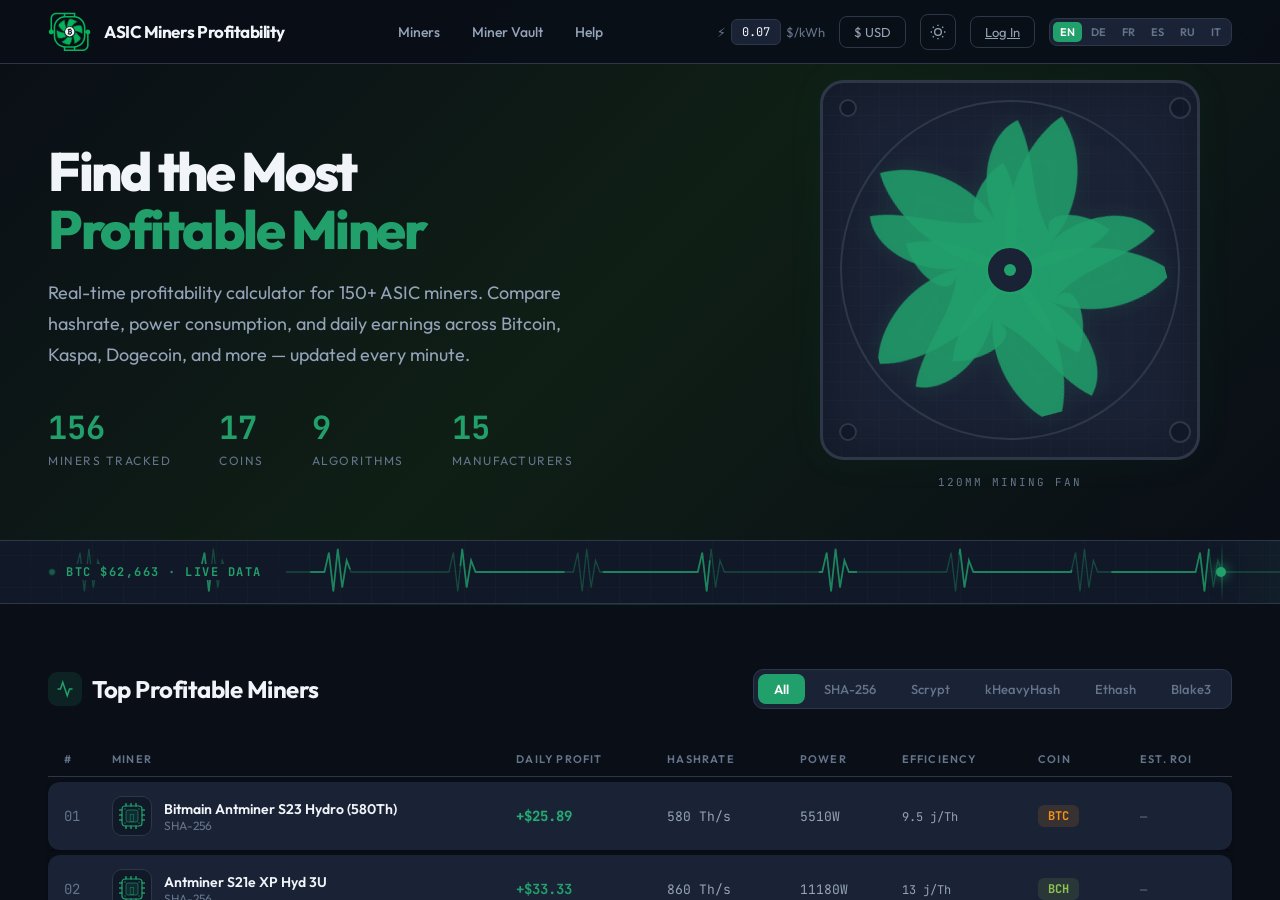
In our experience shipping to customers across 27 EU countries, the biggest mistake beginners make is calculating profitability based on today's difficulty and today's Bitcoin price, then treating that number as permanent. Both variables move constantly. Use a tool like asicminersprofitability.com and run scenarios at 20% higher difficulty and 20% lower BTC price. If those scenarios still work for you at your electricity rate, you are in a reasonable position.
Solo mining is a separate conversation. At 200 TH/s on a network of ~900 EH/s, your probability of finding a block solo in a given day is vanishingly small — roughly 1 in 12,500. That is not a reason to avoid it, necessarily, but it is a reason to understand what you are doing. The solo mining probability calculator at soloblocks.io will give you exact odds for your specific hashrate.
How Three Real Miners Compare at European Electricity Rates
Here is a concrete comparison using machines available through Mineshop's current ASIC catalogue, at two common European electricity rates. Bitcoin price used: $60,057 USD (live rate at time of writing). Profitability figures are indicative and change with difficulty and BTC price.
| Miner | Hashrate | Power Draw | Efficiency | Monthly Power Cost (€0.20/kWh) | Monthly Power Cost (€0.28/kWh) |
|---|---|---|---|---|---|
| Bitmain Antminer S21 XP Hyd | 473 TH/s | 5,676 W | 12.0 J/TH | ~€817 | ~€1,144 |
| Whatsminer M63S+ | 390 TH/s | 5,304 W | 13.6 J/TH | ~€764 | ~€1,069 |
| Bitmain Antminer S21+ | 216 TH/s | 3,500 W | 16.2 J/TH | ~€504 | ~€706 |
The takeaway is not simply "buy the most efficient machine." The S21 XP Hyd produces more hashrate — and therefore more gross Bitcoin — but its power draw requires industrial electrical infrastructure most home miners do not have. The Antminer S21+ is the more realistic home-miner option, and at €0.20/kWh it can still generate a positive margin. At €0.28/kWh, margins are thin. Very thin. (Source: Bitmain.com, 2026; MicroBT.com, 2026)
If you are exploring alternatives beyond Bitcoin SHA-256, the IceRiver KAS miner range operates on a different algorithm entirely and may suit home environments better — quieter, lower power draw, different risk profile.
What European Home Miners Should Actually Do With This Information
Check your electricity tariff first. Not second. First. Everything else — which miner, which pool, which algorithm — is downstream of that number. If you are above €0.25/kWh on a fixed residential tariff, Bitcoin mining on current-gen SHA-256 hardware is not going to pencil out unless BTC price moves substantially higher or you can negotiate a commercial rate.
The counterintuitive advice most articles will not give you: a lower-hashrate machine with better efficiency will often outperform a higher-hashrate machine with worse efficiency at European power prices. A 140 TH/s miner at 14 J/TH beats a 200 TH/s miner at 25 J/TH in net profit — every single month — once you do the arithmetic.
Mineshop.eu has been supplying European miners with genuine ASIC hardware since 2016, with EU warehouse stock in Ireland and fast DHL/FedEx delivery across all EU countries. The machines we see returned most often are not defective — they are profitable on paper but incompatible with the buyer's home electrical setup or electricity rate. Know your numbers before you order.
For home and smaller-footprint options, the home miner category and mini Bitcoin miners are worth exploring if you are working with standard household circuits and do not want to rewire your garage.
Frequently Asked Questions
What is hashrate in Bitcoin mining?
A: Hashrate is the number of SHA-256 hash computations a mining device performs per second — each one an attempt to find a valid Bitcoin block. It is measured in terahashes per second (TH/s) for individual ASICs, and in exahashes per second (EH/s) for the full network. The Bitcoin network currently operates at approximately 800–1,000 EH/s as of Q1 2026 (Source: mempool.space, Q1 2026).
Does higher hashrate always mean more profit?
A: No. Higher hashrate typically means higher power draw, and electricity is your primary ongoing cost. A miner doing 200 TH/s at 25 J/TH uses around 5,000 watts and costs roughly €360/month at €0.25/kWh. A 140 TH/s machine at 14 J/TH uses 1,960 watts and costs about €141/month. The lower-hashrate machine often nets more profit — sometimes significantly more — because of the power cost difference.
What is a good J/TH efficiency for a Bitcoin miner in 2026?
A: Any miner below 15 J/TH is considered current-generation efficient for 2026. The best air-cooled units sit around 12–17 J/TH. Immersion and hydro-cooled miners can reach below 10 J/TH, though they require specialist infrastructure. Anything above 25 J/TH is older-generation hardware that will struggle at European electricity rates above €0.20/kWh.
How does network hashrate affect my mining earnings?
A: Your expected earnings are proportional to your share of total network hashrate. As the network grows — it has expanded from roughly 200 EH/s in 2022 to 800–1,000 EH/s by Q1 2026 — the same machine earns less Bitcoin per day, because the pool reward is spread across more participants. Bitcoin difficulty adjusts every 2,016 blocks (~2 weeks) to compensate for hashrate changes, keeping block production at roughly 144 blocks per day.
What block reward do Bitcoin miners receive in 2026?
A: Since the April 2024 halving, the block reward is 3.125 BTC per block. At approximately 144 blocks per day, the network collectively issues around 450 BTC per day. Individual miners receive a share of each block reward proportional to their contributed hashrate within their mining pool.
Is home Bitcoin mining profitable in Europe in 2026?
A: It depends heavily on your electricity rate. At €0.20/kWh with a current-generation miner (sub-16 J/TH), margins exist but are narrow. At €0.28/kWh — typical in Germany or Denmark — profitability is very tight at current Bitcoin prices around $60,057 USD. Miners in countries with lower residential rates (Latvia, Bulgaria, parts of Eastern Europe) are better positioned. Always model your specific electricity cost before purchasing hardware. (Source: Eurostat, Q4 2025)
Ready to compare machines for your setup? Browse the full range of available ASIC miners at Mineshop.eu — with EU stock in Ireland, no import hassle, and direct support from a team that has been doing this since 2016. If you are unsure which miner fits your electricity rate and space, get in touch before you buy.
Related Blog
Goldshell KA Box apskats: kompakts Kaspa ASIC racējs mājas lietošanai
Jul 8, 2024 by Guntis Vitolins
Mineshop
Mēs iedziļināsimies detaļās par mazu, bet jaudīgu ierīci, kas ir lieliski piemērota mājas lietotājiem — Goldshell Kaspa Coin ASIC racēju. Ņemot vērā jaunu izlaidumu biežumu, dažreiz
Labākā elektrības cena Bitcoin ieguvei, lai saglabātu rentabilitāti
Apr 5, 2026 by Guntis Vitolins
Mineshop
12 visrentablākie kriptovalūtu ieguves iekārtu modeļi 2025. gadā | Pelni €500+ dienā ar labākajiem ASIC
May 27, 2025 by Guntis Vitolins
Mineshop
AI darbstacija, kas atmaksājas, kamēr tā darbojas dīkstāvē
Jul 26, 2026 by Guntis Vitolins
Mineshop