



After the April 2024 halving, the Bitcoin network cut its block reward from 6.25 BTC to 3.125 BTC — and most beginner guides still have not caught up. That gap between what the internet tells you and what is actually happening on-chain is exactly where bad hardware decisions get made.
The bitcoin block reward miners guide you actually need is not a glossary. It is a clear-eyed look at how much Bitcoin the network produces, who gets it, and whether your electricity rate — say €0.22/kWh in Austria or €0.28/kWh in Germany — lets you keep any of it. The maths is not complicated. The consequences of ignoring it are.
What We Cover
- How block rewards actually work
- What 3.125 BTC per block means in euros
- Efficiency and your electricity bill
- Miner comparison: who gets paid what
- Solo mining vs pool mining
- Frequently Asked Questions
- What you now know how to answer
How Block Rewards Actually Work
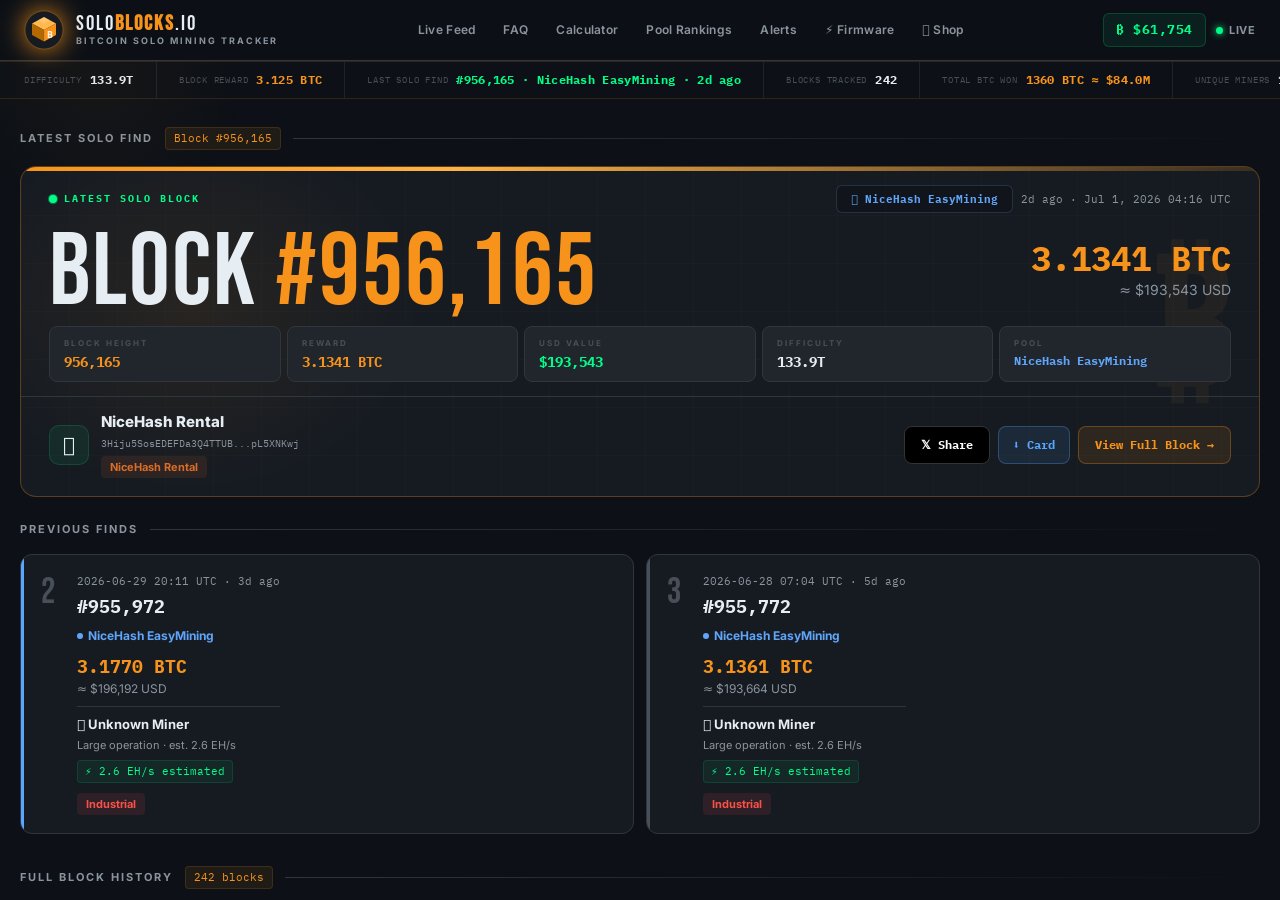
A Bitcoin block reward is the fixed amount of new BTC issued to whichever miner solves a block first. Right now that is 3.125 BTC per block (Source: mempool.space, as of Q1 2026). The network produces roughly 144 blocks every day, which means approximately 450 BTC enters circulation daily. That is it. That is the entire budget the network uses to compensate miners for their electricity.
The reward halves every 210,000 blocks — roughly every four years. The April 2024 halving was the fourth. The next one is expected around 2028, when the reward drops to 1.5625 BTC. Every halving is a pay cut for miners that the network does not apologise for.
Where transaction fees fit in
On top of the block subsidy, miners also collect transaction fees from every transaction included in their block. Historically, fees have been a minor supplement — maybe 1–5% of total revenue on a quiet day. But during periods of network congestion (the Ordinals boom in early 2023 was a vivid example), fees temporarily exceeded the block subsidy. Do not count on fees as a reliable income stream. They are a bonus, not a salary.
What 3.125 BTC Per Block Means in Euros
At a Bitcoin price of approximately $61,695 USD (as of Q1 2026), each block reward is worth roughly $193,000 — or around €178,000 at current exchange rates. Sounds enormous. And it is, split between a solo miner who found that block outright or divided proportionally across a pool of thousands of machines contributing hashrate.
The network hashrate sits between 800 and 1,000 EH/s right now (Source: mempool.space, Q1 2026). That means competition for those 144 daily blocks is brutal. A single Antminer S21 XP running at 270 TH/s — one of the most efficient SHA-256 machines currently available — contributes roughly 0.000000027% of total network hashrate. Your expected daily earnings from pool mining at that hashrate, before electricity, run somewhere around €2.00–€2.50 per day depending on BTC price. Honestly, that is not great margin if you are paying €0.28/kWh in Germany.
The citable definition
A Bitcoin block reward is a consensus-enforced issuance mechanism that grants the winning miner a fixed subsidy — currently 3.125 BTC — plus all transaction fees included in that block, issued every ~10 minutes, with the subsidy halving every 210,000 blocks to enforce Bitcoin's 21 million coin supply cap.
Efficiency and Your Electricity Bill: The Number That Actually Matters
Most mining guides spend two paragraphs on hashrate and one sentence on efficiency. That order is backwards. Hashrate tells you how many lottery tickets you buy. Efficiency tells you how much each ticket costs.
Efficiency is measured in joules per terahash (J/TH). Lower is better. An older machine running at 30 J/TH uses more than twice the electricity of a modern machine at 13.5 J/TH to produce the same hashrate. At €0.25/kWh — a reasonable European average (Eurostat, Q4 2025) — that difference is not abstract. Running a 30 J/TH machine at 150 TH/s costs about €27/day in electricity. A 13.5 J/TH machine at the same hashrate costs about €12/day. That is €450/month. Real money.
In our experience shipping to customers across 27 EU countries, the biggest mistake beginners make is buying on hashrate alone and ignoring the efficiency rating entirely — then wondering why their electricity bill erased their mining income by month three.
Worth knowing before you buy: EU household electricity rates range from roughly €0.14/kWh in Hungary to over €0.30/kWh in Germany and Denmark (Eurostat, Q4 2025). If your rate is above €0.22/kWh, efficiency is not just important — it is the only variable that decides whether you break even.
Miner Comparison: Who Gets Paid What
Here is a straightforward look at current hardware options available from Mineshop's ASIC miner catalogue, with real specs and real electricity cost estimates at €0.22/kWh.
| Miner | Hashrate | Power Draw | Efficiency | Daily Elec. Cost (€0.22/kWh) |
|---|---|---|---|---|
| Antminer S21 XP | 270 TH/s | 3,645W | 13.5 J/TH | ~€19.20 |
| Whatsminer M63S+ | 390 TH/s | 7,410W | 19.0 J/TH | ~€39.10 |
| Antminer S21 (home config) | 200 TH/s | 3,500W | 17.5 J/TH | ~€18.50 |
These numbers assume continuous 24/7 operation. Pool fees (typically 1–2%) are not included. Profitability depends entirely on BTC price, difficulty, and your electricity rate — all three of which move independently of each other.
Solo Mining vs Pool Mining: One Is a Lottery Ticket
Pool mining is how almost all home miners participate. You contribute your hashrate to a shared pool, and the pool pays you a proportional cut of every block it finds — smoothing out the variance into a predictable (if small) daily payout. This is the rational choice for anyone with less than a few petahashes.
Solo mining means your machine works alone. If it finds a block, you collect the full 3.125 BTC reward. If it does not — and statistically, a single S21 XP at 270 TH/s against 900 EH/s of network hashrate would take tens of thousands of years to find one block on average — you earn nothing. You can model your personal odds at soloblocks.io/calculator. The numbers are sobering.
There is a counterintuitive argument for solo mining that most guides completely ignore: if you are mining as a hobby and your electricity cost is already covered (say, by solar panels or a business arrangement), the expected value of pool mining and solo mining is mathematically identical. The difference is variance. Solo mining is just a much wilder ride to the same destination — and occasionally, someone does win. People hit blocks solo. It happens. It is just not a business plan.
Frequently Asked Questions
What is the current Bitcoin block reward in 2024 and 2025?
A: The current block reward is 3.125 BTC per block, following the fourth Bitcoin halving in April 2024. At a Bitcoin price of approximately $61,695 USD (Q1 2026), that is roughly $193,000 per block, paid to the miner or pool that solves it first. The next halving, expected around 2028, will reduce this to 1.5625 BTC.
How many Bitcoin blocks are mined per day?
A: The Bitcoin protocol targets one block every 10 minutes, which works out to approximately 144 blocks per day. The network adjusts mining difficulty every 2,016 blocks (roughly every two weeks) to maintain this pace regardless of how much hashrate is connected to the network.
Can a home miner realistically earn a Bitcoin block reward?
A: Technically yes, through solo mining — but the odds are extremely low. A single Antminer S21 XP at 270 TH/s against a network hashrate of ~900 EH/s has roughly a 1-in-3,333,333 chance of solving any given block. Pool mining distributes rewards more predictably and is the approach used by the vast majority of home miners in Europe.
What happens to Bitcoin block rewards after all 21 million BTC are mined?
A: The block subsidy approaches zero around the year 2140. After that, miners will rely entirely on transaction fees for revenue. Whether those fees will be sufficient to secure the network is an open and genuinely contested question in Bitcoin research — it is one of the most significant long-term uncertainties in the protocol.
How does mining difficulty affect my block reward earnings?
A: Mining difficulty does not change the block reward itself — that is fixed at 3.125 BTC. But difficulty directly affects how often your hardware contributes to finding blocks. As more hashrate joins the network (currently 800–1,000 EH/s), difficulty rises and your share of block rewards shrinks proportionally, even if your hashrate stays constant.
What electricity rate do I need to mine Bitcoin profitably in Europe?
A: With current hardware efficiency around 13.5–17.5 J/TH and Bitcoin at ~$61,695, most analysis suggests €0.20/kWh is approximately breakeven for efficient modern miners. Below €0.18/kWh, margins become meaningful. Above €0.25/kWh, you are likely paying more in electricity than you earn — unless BTC price rises significantly. EU household rates average €0.20–0.30/kWh (Eurostat, Q4 2025), which makes home mining marginal in most countries at current prices.
What You Now Know How to Answer
The bitcoin block reward miners guide that actually helps you is one that connects protocol mechanics to your electricity meter. The reward is 3.125 BTC. The network produces 144 blocks a day. Your cut of that depends on your hashrate share, your machine's efficiency, and whether your electricity rate leaves anything over after the bill is paid.
Mineshop.eu has been supplying European miners with genuine ASIC hardware since 2016; most orders ship from Ireland and Latvia, both in the EU, with fast DHL/FedEx delivery across all EU countries. We have seen firsthand that the miners who do well long-term are the ones who ran the electricity maths before they bought — not after.
If you are starting out or upgrading, browse our home miner range or the full ASIC miner catalogue. If noise and space are concerns, the mini Bitcoin miners section is worth a look. And if you have questions about which machine fits your electricity rate and setup, contact us directly — that is what we are here for.
Comments (0)