


What if your Bitcoin miner paid for itself while your electricity bill stayed at zero? Mining Bitcoin with solar power at home is no longer a niche experiment — in 2026, thousands of European home miners are pairing solar panels with compact ASICs to mine crypto at near-zero marginal cost. If you have roof space and a miner, this guide is for you.
In this article we break down exactly how to set up a solar-powered home mining operation: how much panel capacity you actually need, which miners work best with variable power, and whether the numbers make sense for a typical European home.
What We Cover
- Why Solar Power and Bitcoin Mining Are a Natural Fit
- How Much Solar Power Does a Home Miner Need?
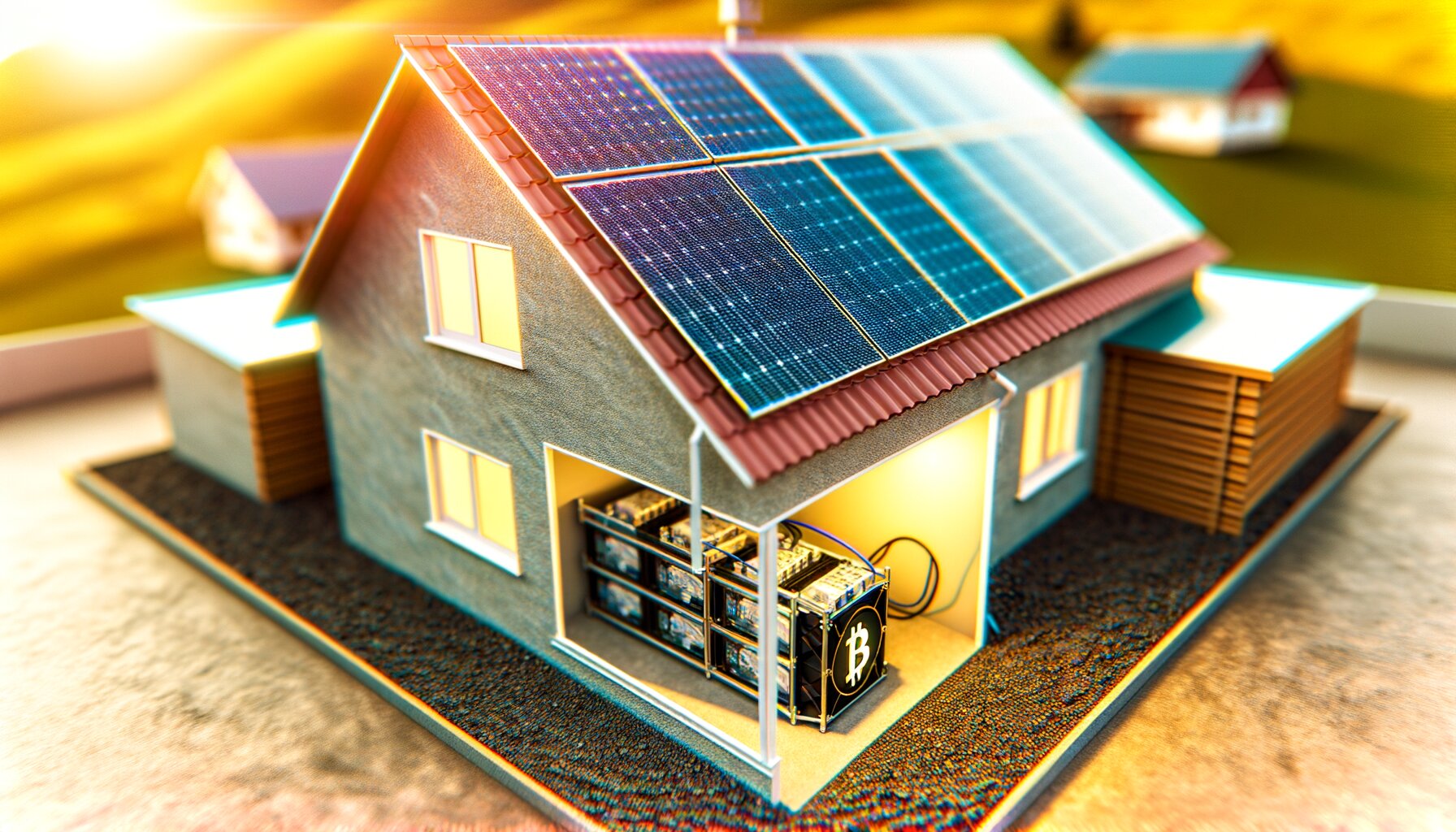
- Setting Up Your Solar Mining System
- Best Miners for Solar Setups
- Is Solar Bitcoin Mining Actually Profitable?
- Practical Tips for Solar Home Miners
Why Solar Power and Bitcoin Mining Are a Natural Fit
Bitcoin mining has one dominant cost driver: electricity. An ASIC miner runs 24/7, drawing anywhere from 200 watts (a mini miner) to 3,500 watts (a top-tier industrial unit). At European grid rates of €0.20–0.35/kWh, electricity alone can make or break your profitability.
Solar panels generate power during daylight hours — which is exactly when most home miners are already running. Modern solar installations with battery storage can extend coverage well into the evening. And unlike heating your home with a miner (a great strategy too), solar mining lets you generate both clean energy and Bitcoin simultaneously.
The Key Advantage: Near-Zero Marginal Cost
Once solar panels are installed, the electricity they produce costs you nothing extra. Every watt-hour consumed by your miner during solar production is essentially free. Even if you only cover 6–8 hours of mining per day with solar, that slashes your effective electricity cost by 25–35% — which can flip a marginal operation into a profitable one.
Grid Feed-in vs Self-Consumption
In most European countries, feeding excess solar power back to the grid pays a low rate (often €0.04–0.08/kWh). Using that same power to mine Bitcoin instead can yield significantly more value per kWh, making self-consumption the smarter choice for miners with solar.
How Much Solar Power Does a Home Miner Need?
The answer depends entirely on which miner you run. Here are realistic numbers for popular home mining units:
- Mini miners (200–400W): A 1–2 kWp solar array can cover full daytime operation. Even a single 400W panel can power a mini miner during peak hours.
- Mid-range ASICs (1,000–1,500W): You will need 3–5 kWp of panels to cover daytime consumption and leave surplus for the home.
- High-performance ASICs (2,500–3,500W): 8–12 kWp installations are required. Feasible on larger roofs, but generally better suited to semi-industrial setups.
Battery Storage: Worth It for Mining?
Adding a home battery (e.g. a 10 kWh LiFePO4 system) lets you mine through the night on stored solar energy. The economics depend on battery cost and Bitcoin price, but for 2026 conditions — with BTC above $80,000 — many setups are crossing into positive ROI territory within 3–4 years including battery costs.
Setting Up Your Solar Mining System
A basic solar home mining setup has four components:
- Solar panels — Mounted on roof or ground frame. Standard residential panels are 400–430W each.
- Inverter / charge controller — Converts DC solar output to AC for your miner. A hybrid inverter manages both grid connection and battery.
- Battery bank (optional but recommended) — Stores excess daytime generation for evening mining.
- ASIC miner — Plugged into a standard outlet fed by the solar inverter. No special modifications needed for most miners.
Grid-Tie vs Off-Grid
Most home setups are grid-tied: your miner draws from solar when available and automatically switches to grid power when solar is insufficient. This requires no manual intervention — the miner just keeps hashing. Fully off-grid setups are possible but require more battery capacity and careful load management.
Power Stability and Miner Safety
ASICs are sensitive to voltage fluctuations. A good hybrid inverter (such as those from Growatt, SMA, or Huawei) maintains stable 230V AC output regardless of solar variability. Avoid cheap modified sine wave inverters — they can damage ASIC power supplies over time.
Best Miners for Solar-Powered Home Setups
For solar mining, efficiency matters more than raw hashrate. A miner that draws less power gives you more hashing hours per kWh of solar generation. Our top picks for solar home mining in 2026:
Mini Miners (Best for Small Solar Setups)
If your solar installation is 1–3 kWp, mini Bitcoin miners are your best match. Units like the Avalon Nano series draw under 140W and run near-silently — ideal for daytime operation in a living space. Check our full range of home mining hardware for currently available models.
Efficient Mid-Range ASICs
For 4–8 kWp solar systems, a mid-range ASIC miner in the 1,000–1,500W range offers the best balance of hashrate and solar compatibility. Models with efficiency ratings below 20 J/TH are particularly well-suited. Browse our Bitmain miner collection and IceRiver ASIC range for the latest efficient units.
Is Solar Bitcoin Mining Actually Profitable in 2026?
Let us run a realistic example. Suppose you install a 3 kWp solar system and run a 350W mini miner during the 7 peak solar hours per day (European average in summer):
- Daily solar mining: 7 hours × 0.35 kW = 2.45 kWh consumed by the miner at €0/kWh
- Evening mining (4 hours from grid): 4 × 0.35 kW × €0.25 = €0.35/day grid cost
- Total daily electricity cost vs full-grid mining (11h × €0.25): €2.75 → reduced to €0.35
- Annual saving: ~€880/year just on electricity
At current Bitcoin prices and mining difficulty, that saving alone can represent a meaningful improvement in ROI. Use the ASIC miners profitability calculator to model your exact setup with your local electricity rate and panel output.
Winter Considerations in Europe
European winters cut solar generation significantly — in Latvia or Germany, you might get only 2–3 peak solar hours per day in December. Plan your profitability model around annual averages (roughly 4–5 peak hours/day in Central/Northern Europe) rather than summer peaks alone.
Practical Tips for Solar Home Miners
- Start small: A single 400W panel powering a mini miner is a low-cost way to test the concept before committing to a full installation.
- Time your mining: Some miners allow scheduled downtime. Set your miner to run primarily during solar hours if you want to minimize grid draw without battery storage.
- Monitor consumption: Smart plugs with energy monitoring (e.g. Shelly) let you track exactly how much solar vs grid power your miner is consuming.
- Underclock at night: Running your miner at 70–80% power during off-solar hours reduces your grid electricity cost while keeping the miner earning.
- Check local solar incentives: Many EU countries offer installation subsidies or zero-VAT on residential solar in 2026 — this substantially improves the economics.
Frequently Asked Questions
Can you mine Bitcoin with solar power at home?
A: Yes — solar-powered Bitcoin mining is practical and increasingly common in 2026. Home miners pair low-to-mid wattage ASIC miners with rooftop solar systems. The key constraint is matching miner power draw to available solar generation. A 4 kW solar system (typical European residential install) can power one Antminer S21+ (3,360W) during peak sunlight hours, or several home miners like the Avalon Nano 3S (140W) around the clock with battery storage.
How many solar panels do you need to run a Bitcoin ASIC miner?
A: A standard 400W solar panel generates approximately 1.2–1.6 kWh per day in Northern Europe (less in winter). To run an Antminer S21+ (3,360W) requires roughly 10–12 × 400W panels to cover daytime-only operation. For a home miner like the Avalon Nano 3S (140W), a single 400W panel is sufficient with 8–10 hours of direct sunlight. (Source: EU solar irradiance data, PVGIS, 2025.)
What is the best Bitcoin miner for solar power in 2026?
A: The best solar mining setups in 2026 use low-power devices for 24/7 operation or efficient mid-range miners during peak solar hours. Top picks: NerdQAxe+ Ultra (25W — runs all day on a small panel + battery), Avalon Nano 3S (140W — ideal for 1–2 panel setups), Antminer S21+ (3,360W — needs a full residential solar array). Browse home miners at Mineshop.eu.
Is solar Bitcoin mining actually profitable in 2026?
A: At €0.00/kWh effective electricity cost (fully solar-powered), even mid-efficiency miners become profitable. The Antminer S21+ (15.6 J/TH) at zero electricity cost earns approximately €10–18/day gross at BTC ~€80,000. The solar system cost (€6,000–10,000 for a 4 kW array) adds 18–36 months to payback. The winning scenario: combine solar with grid as backup, mine 24/7, and benefit from both heating offset and BTC earnings.
Do you need batteries for solar Bitcoin mining?
A: Batteries are optional but significantly improve efficiency. Without batteries, you only mine during daylight solar generation. A 10 kWh battery system (e.g. Tesla Powerwall ~€8,000–11,000) stores enough energy for the Avalon Nano 3S to run through the night, or for a larger miner to run 4–6 additional hours. For small home miners (under 200W), even a 2 kWh battery (~€800–1,200) extends operation through evenings.
What are the biggest challenges of solar Bitcoin mining?
A: The three main challenges: (1) Seasonal variance — Northern European winters produce 70–80% less solar energy than summers. (2) Inverter compatibility — most ASICs need stable 240V AC power; DC-coupled systems require additional converters. (3) Battery costs — high upfront cost delays overall ROI. Best mitigations: size your system for winter averages, use a quality hybrid inverter, and start with low-wattage miners that don't require large battery banks.
Ready to Start Solar Mining?
The combination of solar panels and a home ASIC miner is one of the most compelling setups for long-term, low-cost Bitcoin mining in 2026. Whether you go with a quiet mini miner on a balcony solar panel or a full rooftop array powering a serious ASIC rig, the principle is the same: cheaper electricity means better returns.
Browse our full selection of home mining hardware at Mineshop.eu — we stock miners suited to every power budget, from under 200W to full-scale units. We ship across Europe with fast delivery.
Have questions about which miner fits your solar setup? Contact our team — we are happy to help you find the right match.
Mineshop.eu has been supplying European miners with genuine ASIC hardware since 2016; most orders ship from Ireland and Latvia, both in the EU, with fast DHL/FedEx delivery across all EU countries.