



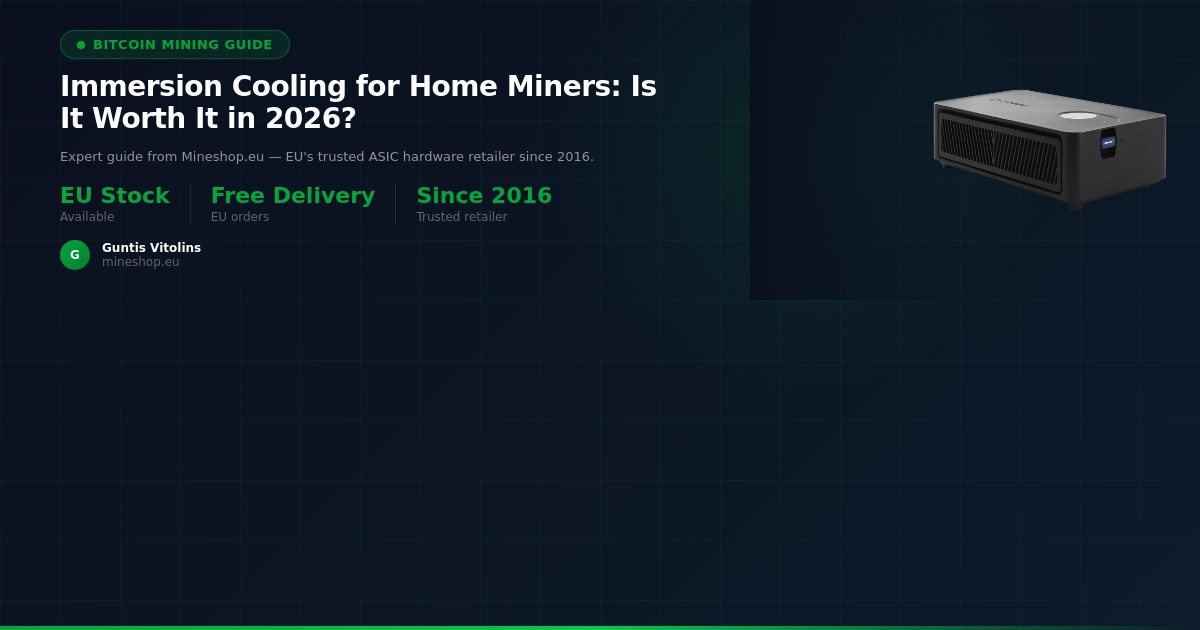
Immersion Cooling for Home Miners: Is It Worth It in 2026?
Plenty of home miners in Europe are running their rigs in a spare bedroom, a garden shed, or a garage corner — and the noise alone is enough to end a marriage. So when someone mentions immersion cooling, the pitch is obvious: silent operation, lower temperatures, longer hardware life. But the reality is messier, and the cost calculation rarely works out the way the YouTube videos suggest.
Immersion cooling for a home miner is not a weekend project. It is a commitment that starts at around €2,000–€4,000 before you have mined a single satoshi extra. For some setups — a small farm, a dedicated outbuilding, a miner running 24/7 at high ambient temperatures — it makes real sense. For the person running a single home miner in a Dutch apartment, it almost certainly does not.
Here is what the honest version of this conversation looks like.
What We Cover
- What immersion cooling actually is (and the spec that matters)
- The real upfront and ongoing costs in euros
- When immersion cooling makes sense for a home miner
- The alternatives most guides skip entirely
- Should you actually do it?
What Immersion Cooling Actually Is
Immersion cooling is a thermal management method in which ASIC mining hardware is fully submerged in a dielectric fluid — a non-conductive liquid that absorbs heat directly from chips and components — allowing sustained operation at lower junction temperatures and, in most systems, near-silent running. The fluid used is typically a mineral oil or purpose-built engineered fluid such as 3M Novec or Engineered Fluids EC-100, with thermal conductivity roughly 1,000 times better than air at the chip surface.
The hardware community distinguishes between two main types. Single-phase immersion submerges the miner in liquid that stays liquid — heat is removed by circulating the fluid through an external heat exchanger. Two-phase systems use a fluid that boils at a low temperature, vaporises, condenses on a cooled lid, and drips back down. Two-phase is more efficient. It is also significantly more expensive and complex, and essentially nobody running a home setup uses it.
For a single-phase home setup, the core components are a tank (typically a chest or custom-fabricated container), dielectric fluid (around 150–200 litres for a single large ASIC), a pump, and a heat exchanger or radiator. The miner itself — the Bitmain Antminer S23 Hyd, for instance, is already designed for liquid cooling from the factory. Standard air-cooled units require fan removal and sometimes additional preparation before submerging.
The Real Upfront and Ongoing Costs
What you will actually spend
A basic single-phase immersion tank from a reputable supplier runs €800–€1,500. Add 150 litres of dielectric fluid at roughly €5–€8 per litre — that is €750–€1,200 for the fluid alone. A decent pump and heat exchanger adds another €300–€600. You are at €2,000–€3,300 before you buy the miner.
Honestly, that is not great when the miner itself might cost €1,500–€4,000. You are doubling your capital outlay for a cooling improvement.
Then there is the ongoing side. Dielectric fluid degrades over time and needs topping up or replacing. Engineered fluids are not the kind of thing you pick up at a hardware store. Leaks — and they do happen, especially with DIY tanks — are messy and expensive. And if you ever need to move the hardware or sell it on, extracting a miner from 150 litres of oil and cleaning it properly is a full afternoon's work.
Does it save electricity?
Yes, marginally. Lower chip temperatures allow for slightly more aggressive overclocking without throttling, and the removal of fans eliminates fan power draw — typically 30–80W per unit. On a miner drawing 3,500W, saving 50W is a 1.4% efficiency gain. At €0.25/kWh (close to the EU average per Eurostat, Q4 2025), that saves roughly €2.70 per month. Not nothing. But not the number that changes your ROI calculation meaningfully.
Where immersion genuinely helps is longevity. ASICs running cooler consistently outlast air-cooled equivalents. Capacitors last longer. Hashboards degrade more slowly. If you plan to run hardware for 4–5 years, that matters. If you are the type who upgrades every generation, it matters less.
When Immersion Cooling Makes Sense for a Home Miner
Say you live in southern Spain or Cyprus, where summer ambient temperatures regularly hit 35–38°C. Air cooling an S23 Hyd or a high-density unit in those conditions means your fans are screaming at maximum RPM, your hash rates are throttling, and your hardware is running hot all season. Immersion removes ambient temperature from the equation almost entirely. That is a legitimate use case.
Or say you are running four or more units in a dedicated space. The noise from four high-performance ASICs is genuinely intolerable without industrial ear protection, and a well-built immersion tank running four miners can bring the acoustic output down to near-silence. The cost per unit drops significantly when you are spreading tank and fluid costs across multiple machines.
Running a hydro-cooled unit like the Antminer S23 Hyd is a cleaner entry point than converting an air-cooled machine — the hardware is already designed for liquid, and you skip the fan-removal preparation step. Mineshop.eu has been supplying European miners with genuine ASIC hardware since 2016; most orders ship from Ireland and Latvia, both in the EU, with fast DHL/FedEx delivery across all EU countries.
But for a single miner in a temperate climate — Germany, the Netherlands, Ireland — where ambient temperatures are manageable and you are not running a multi-unit setup? The cost-benefit is hard to justify.
The Alternatives Most Guides Skip Entirely
Most immersion cooling articles are written by people trying to sell you immersion cooling equipment. So they skip the part where they tell you that a properly ventilated enclosure, a dedicated intake fan, and a cold-side air duct solve 80% of the noise and heat problems at a fraction of the cost.
For European home miners who want lower noise and better thermals without a full immersion build, the more practical options are:
- Hydro-cooled ASICs that use closed-loop water cooling from the factory — no tank, no fluid prep, just plumbing to a radiator or household heating circuit
- Mini and compact miners that are designed for home use from the start, with noise levels under 45 dB — genuinely liveable in a home environment
- Acoustic enclosures — a ventilated wooden or foam-lined box around a standard ASIC can cut perceived noise by 15–20 dB without touching the cooling architecture
The Goldshell AE Box Pro, for instance, is built for home environments — 44 MH/s on ALEO, low noise, compact form factor. No immersion required, no tank, no fluid. That is the smarter entry point for most beginners, not a DIY oil bath.
Comparison: Cooling Options for Home Miners
| Method | Setup Cost | Noise Level | Maintenance | Best For |
|---|---|---|---|---|
| Air cooling (standard ASIC) | €0 extra | 75–85 dB | Low | Garage, shed, outbuilding |
| Hydro-cooled ASIC (factory) | €200–€500 extra (plumbing) | 40–55 dB | Low–medium | Home office, multi-unit setups |
| Single-phase immersion (DIY) | €2,000–€3,500 | Under 45 dB | High | 4+ units, hot climates |
| Mini/compact home miner | €0 extra | 35–45 dB | Very low | Beginners, apartments, bedrooms |
Should You Actually Do It?
For the majority of European home miners running one or two units, immersion cooling is a solution that costs more than the problem it solves. The upfront investment of €2,000–€3,500 adds 12–24 months to your break-even timeline at current network difficulty (~115 trillion) and a Bitcoin price of around $78,045 USD (as of Q1 2026). That is a long time to wait for quieter fans.
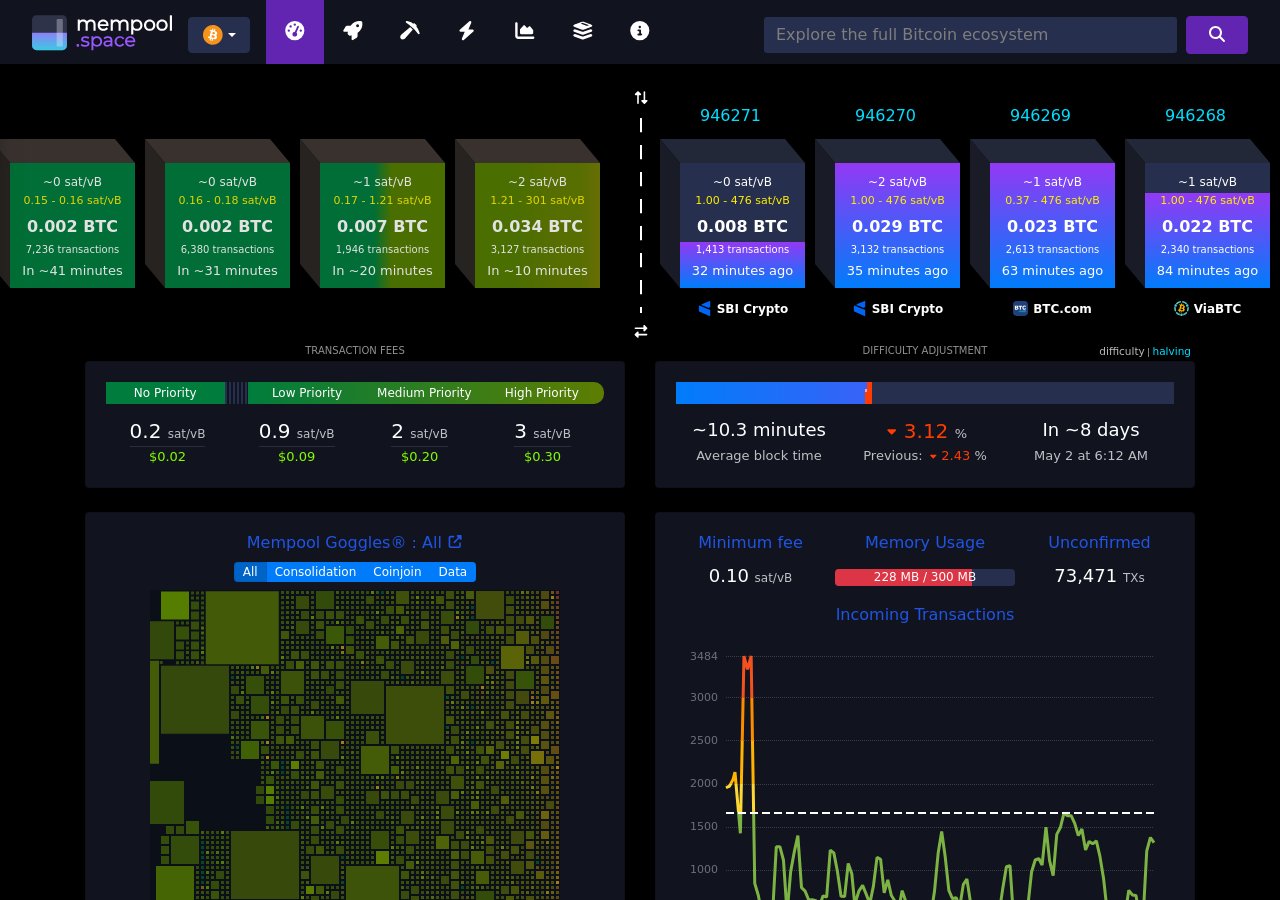
The network hashrate sits at roughly 850–950 EH/s right now (Source: mempool.space, Q1 2026), and with the block reward locked at 3.125 BTC post-April 2024 halving, margins are thin enough that adding unnecessary capital costs is a real risk. If your electricity rate is above €0.25/kWh — which covers most of Germany, Denmark, and Belgium per Eurostat Q4 2025 — adding €3,000 to your setup cost without a proportional efficiency gain is simply bad arithmetic.
In our experience shipping to customers across 27 EU countries, the miners who ask about immersion cooling most urgently are usually the ones who should instead be asking whether their electricity rate makes home mining viable at all. Sort that question first. Then, if you are profitable, running multiple units, and dealing with real thermal or noise problems, immersion starts to earn its price tag.
Otherwise: look at hydro-cooled hardware, look at purpose-built mini miners, and keep your capital in the machine that actually generates the hash — not the tank it sits in.
Frequently Asked Questions
How much does it cost to set up immersion cooling for a home miner?
A: A single-phase immersion cooling setup for one ASIC typically costs €2,000–€3,500 in Europe, covering the tank (€800–€1,500), dielectric fluid at €5–€8 per litre for 150–200 litres, and pump/heat exchanger hardware. Two-phase systems cost significantly more and are not practical for home use. Factory hydro-cooled miners like the Antminer S23 Hyd reduce this to €200–€500 for basic plumbing integration.
Does immersion cooling improve mining profitability?
A: Marginally and indirectly. Eliminating fan draw saves 30–80W per unit — roughly €2–€5/month at €0.25/kWh. Lower operating temperatures can allow modest overclocking gains. The bigger profitability factor is hardware longevity: ASICs running in immersion tend to last longer, which matters if you hold hardware for 4–5 years. But the setup cost of €2,000–€3,500 means payback from efficiency alone takes many years at current Bitcoin prices (~$78,045 USD, Q1 2026).
Can I submerge any ASIC miner in dielectric fluid?
A: Most standard air-cooled ASICs can be prepared for immersion, but it requires removing fans, often modifying firmware, and ensuring all components are compatible with the fluid being used. Factory hydro-cooled units are simpler. Not all dielectric fluids are compatible with all materials — some cheaper mineral oils can degrade certain plastics and adhesives over time. Always verify fluid compatibility before submerging hardware worth thousands of euros.
What is the noise level of an immersion-cooled ASIC?
A: A properly sealed single-phase immersion tank with an external radiator typically produces under 45 dB of noise — comparable to a quiet office environment. Standard air-cooled ASICs run 75–85 dB, which is close to a vacuum cleaner running continuously. The noise reduction is the most immediately noticeable benefit of immersion cooling for home miners.
Is immersion cooling legal and safe for home use in the EU?
A: Yes, immersion cooling is legal in the EU for home use. The main safety considerations are fire risk (most dielectric fluids have high flash points above 130°C, so fire risk is low), leak containment, and proper electrical isolation. Standard mineral oil is not classified as hazardous. Engineered fluids like Novec variants have specific handling requirements. Always use a properly sealed tank and check local building/fire regulations if installing in a residential property.
What is the alternative to immersion cooling for a quiet home mining setup?
A: Factory hydro-cooled ASICs and purpose-built home miners are the most practical alternatives. Mini miners — such as those in the Goldshell AE Box Pro range — operate at 35–45 dB without any liquid cooling infrastructure. Acoustic enclosures around standard ASICs can also reduce perceived noise by 15–20 dB. For most European home miners paying €0.20–€0.28/kWh, a low-noise compact miner offers a better return on setup cost than a full immersion build. (Source: asicminersprofitability.com, Q1 2026)
Browse the full range of ASIC miners at Mineshop.eu — including hydro-cooled units, mini miners, and everything in between. Mineshop offers EU warehouse stock and fast DHL/FedEx delivery, backed by a team with experience since 2016. Most orders ship from Ireland and Latvia, both in the EU. If you are not sure which setup fits your electricity rate and living situation, get in touch directly — we will give you a straight answer.
Comments (0)