



What Is a Mining Pool? How Pool Mining Works
Solo mining Bitcoin in 2026 with a single ASIC is roughly equivalent to buying one lottery ticket and expecting to win every week. The network is sitting at somewhere between 800 and 1,000 EH/s right now (Source: mempool.space, Q1 2026). Your one machine — whatever it is — contributes a fraction of a percent of that. Without a pool, you could run hardware for three years and never see a single block reward.
That is where a mining pool comes in. Not as some optional extra, but as the actual mechanism by which almost every home miner in Europe gets paid.
What We Cover
- What a mining pool actually is
- How pool mining works, technically
- Payout methods: FPPS, PPS+, PPLNS — which one matters
- Comparing the main pools European miners use
- Should you ever mine solo?
- Frequently Asked Questions
What a Mining Pool Actually Is
A mining pool is a coordinated group of miners who combine their hashrate to increase the collective probability of finding a valid Bitcoin block, then split the 3.125 BTC block reward proportionally according to each miner's contributed work. The key metric here is contributed shares — not luck.
Think of it this way. Say you live in Latvia and pay €0.18/kWh. You have one Bitmain Antminer humming in your garage. Your hashrate is real and your electricity costs are real — but the probability of you personally finding a block solo is statistically negligible. By joining a pool, you contribute your hashrate to a much larger combined effort. When the pool finds a block — which happens far more regularly than you would solo — your share of the reward is calculated based on how much valid work you submitted.
The result is a predictable, regular income stream instead of an all-or-nothing gamble. For most home miners, that predictability is the entire point.
How Pool Mining Works, Technically
Here is what actually happens when you point your miner at a pool.
Your ASIC connects to the pool's mining server using the Stratum protocol — a standard communication layer that tells your machine what to work on. The pool gives your miner a specific, slightly easier target than the actual Bitcoin network difficulty. When your miner finds a hash that meets this easier target, it submits it back to the pool as a "share." The pool counts your shares to measure how much work you are doing. Occasionally — when the difficulty is just right — one of those shares also meets the actual Bitcoin network difficulty and becomes a valid block. That triggers the block reward: 3.125 BTC, plus transaction fees, distributed across all participating miners proportionally.
Shares are the accounting unit. More shares mean more payout. The pool tracks this continuously.
What "Pool Hashrate" Means for You
The larger the pool's total hashrate, the more frequently it finds blocks. A pool with 100 EH/s finds roughly one block every 1.5 minutes on average. A pool with 1 EH/s finds one every 2.5 hours. More frequent block finds mean more frequent (smaller) payouts to you — versus less frequent but larger payouts from a smaller pool. Over time, the expected value is nearly identical. But cash flow matters if you are paying electricity bills monthly in euros.
Payout Methods: FPPS, PPS+, PPLNS — Which One Actually Matters
Most mining guides skip explaining payout schemes properly, which is maddening, because the difference between PPLNS and FPPS can be 10–15% of your monthly earnings.
PPS (Pay Per Share)
You get paid a fixed amount for every valid share you submit, regardless of whether the pool actually finds a block. The pool absorbs the variance risk. Predictable. But the pool charges a higher fee — typically 2–4% — to compensate for that risk.
FPPS (Full Pay Per Share)
Like PPS, but it also includes a proportional share of transaction fees in the block — not just the base block reward. After the April 2024 halving reduced the base reward to 3.125 BTC, transaction fees became a bigger slice of total block revenue. FPPS is now the dominant scheme on major pools for exactly this reason.
PPLNS (Pay Per Last N Shares)
Your payout is calculated from a rolling window of recent shares, not a fixed rate. You earn more when the pool gets lucky (finds blocks faster than expected) and less when luck is poor. Fees are typically lower — around 1% — but income is less predictable. Better for miners who run 24/7 and can absorb variance over weeks. Not ideal if you are just starting out.
Honestly, for a European home miner, FPPS is the safer starting point. You know what you are going to earn before your electricity bill arrives.
Comparing the Main Pools European Miners Use
| Pool | Payout Method | Fee | Hashrate (approx.) | Min. Payout |
|---|---|---|---|---|
| Antpool | FPPS / PPS+ | 2.5% | ~180 EH/s | 0.001 BTC |
| Foundry USA | FPPS | 0–2% | ~250 EH/s | 0.001 BTC |
| F2Pool | FPPS | 2.5% | ~100 EH/s | 0.005 BTC |
| Braiins Pool | FPPS / Score | 2% | ~20 EH/s | 0.001 BTC |
(Source: pool operator websites and mempool.space, Q1 2026. Hashrates fluctuate daily.)
Braiins is worth flagging for European miners specifically — it is the only major pool with Stratum V2 support by default, which gives miners slightly more control over which transactions they include. Niche, but real.
Should You Ever Mine Solo in 2026?
Here is the counterintuitive take: yes — but only on specific altcoin networks where your hashrate represents a meaningful share of total network hashrate.
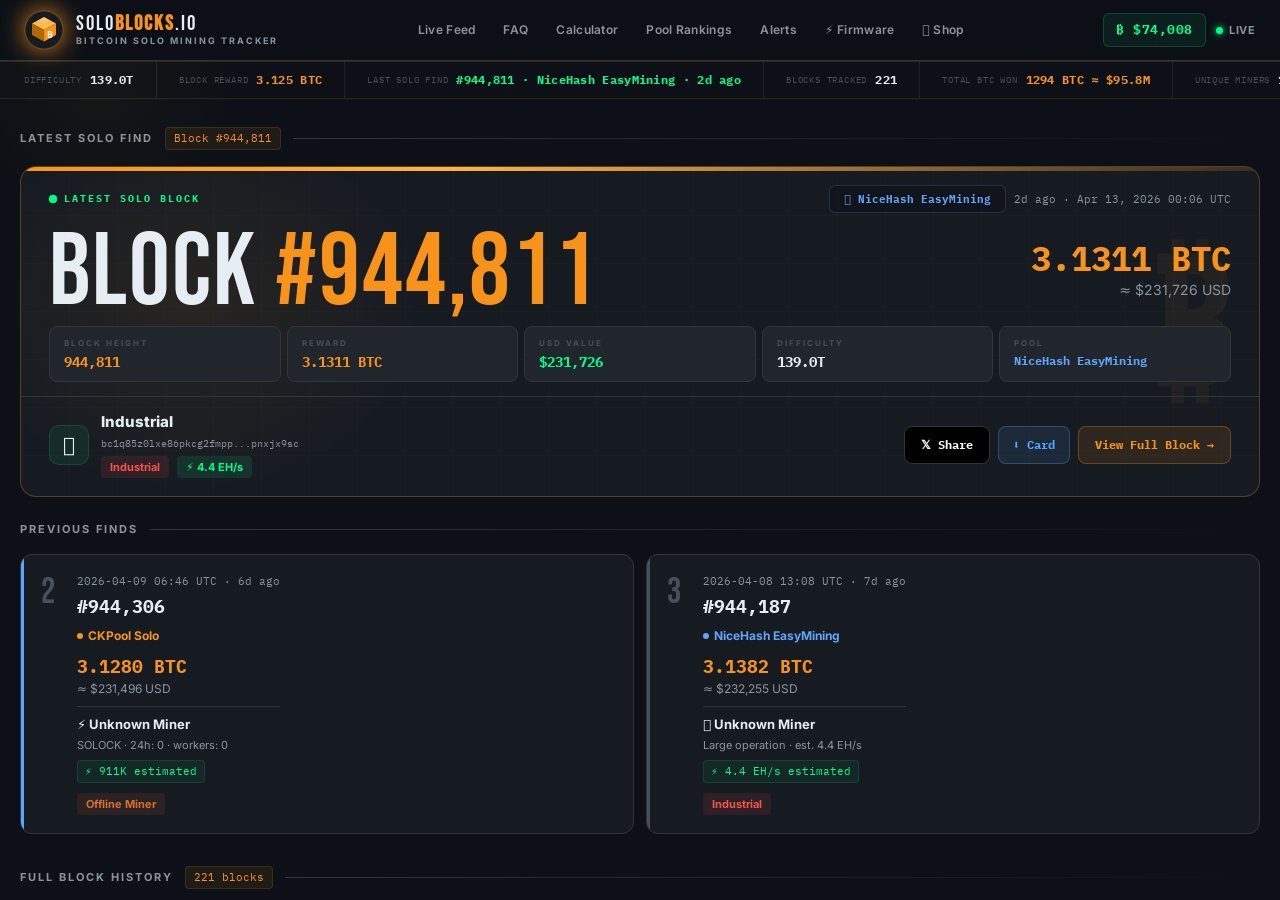
On Bitcoin? No. At 800–1,000 EH/s of global hashrate, a single home machine has a statistically negligible chance of finding a block before a decade passes. The solo mining probability calculator at soloblocks.io makes this painfully clear — plug in any realistic hashrate and the expected time to a solo block will make you reconsider immediately.
For smaller proof-of-work coins — Kaspa, for instance — the network hashrate is orders of magnitude lower. A dedicated IceRiver KAS miner represents a much larger percentage of the Kaspa network than any single Bitcoin ASIC does on Bitcoin. Solo mining on those networks is still a real consideration, not a fantasy.
In our experience shipping to customers across 27 EU countries, the biggest mistake beginners make is conflating "joining a pool" with "giving up control." You do not give up anything meaningful. You still own your hardware, you still get paid in crypto to your own wallet, and you can switch pools in about 90 seconds by changing three lines in your miner's configuration.
For home miners who want predictable monthly income against a known electricity cost — say €0.22/kWh in Germany — pool mining is not just the sensible choice. It is the only choice that makes financial sense. If your electricity bill in Germany runs €0.28/kWh, the difference between solo variance and pool consistency can be the line between profitability and loss in any given month.
Mineshop.eu has been supplying European miners with genuine ASIC hardware since 2016; most orders ship from Ireland and Latvia, both in the EU, with fast DHL/FedEx delivery across all EU countries. Browse the full ASIC miner catalogue to find hardware that pairs well with the pools above.
If you are newer to mining and want something quieter and less demanding to manage, the mini Bitcoin miners category is a sensible place to start — smaller machines, lower power draw, and far less noise than a full industrial unit.
Frequently Asked Questions
What is a mining pool in simple terms?
A: A mining pool is a group of cryptocurrency miners who combine their computing power to improve their chances of earning block rewards. When the pool successfully mines a block, the reward — currently 3.125 BTC on Bitcoin — is split among all participants based on how much hashrate each contributed. It converts unpredictable solo mining into a steady, proportional income stream.
How much does a mining pool charge?
A: Most major Bitcoin mining pools charge between 1% and 2.5% of your earnings as a fee. FPPS pools like Antpool charge around 2.5%, while PPLNS pools like Braiins charge closer to 2%. That fee comes directly off your payout — so on €500/month in gross earnings, you are losing €12.50–€12.50 to fees. Not catastrophic, but worth comparing before you commit. (Source: Antpool, F2Pool, Braiins operator pages, 2026.)
Can I mine Bitcoin without joining a pool?
A: Technically yes. Practically, no — not on Bitcoin. With global network hashrate at approximately 800–1,000 EH/s (Source: mempool.space, Q1 2026), a single home miner's probability of finding a solo block is so low it is measured in years or decades of expected wait time. For smaller altcoin networks with far lower total hashrate, solo mining is still viable.
What is the difference between FPPS and PPLNS?
A: FPPS (Full Pay Per Share) pays you a fixed rate per valid share submitted, including a proportional share of transaction fees. Your income is predictable regardless of the pool's luck on any given day. PPLNS (Pay Per Last N Shares) pays you based on a rolling window of shares — your income fluctuates with the pool's luck. FPPS pools typically charge higher fees (2–2.5%) to compensate for absorbing that variance. For home miners paying fixed monthly electricity bills, FPPS is generally the better fit.
Which mining pool is best for European home miners?
A: There is no single answer, but Antpool, F2Pool, and Braiins are the most commonly used by European operators. Braiins has the advantage of Stratum V2 support and a solid reputation in the European mining community. Foundry USA has the largest hashrate of any single pool (~250 EH/s) but is US-focused. For most beginners, Antpool or Braiins with FPPS payouts is a reasonable starting configuration. Always verify current fee structures directly on pool operator websites before pointing your miner.
How do I connect my ASIC miner to a pool?
A: Log into your miner's web interface (typically via its local IP address on your network), navigate to the mining pool configuration section, and enter the pool's Stratum URL, your pool account username, and a worker name. Most major pools provide exact connection strings in their onboarding pages. The process takes under five minutes for most machines. You can configure up to three pools in most ASIC firmware as backup failovers — which is worth doing so your miner does not sit idle if the primary pool has downtime.
Comments (0)