



Best ASIC Miners for Home Heating in 2026
Your radiator costs you money every month and gives you nothing back. An ASIC miner running in your spare room does the same heating job — and simultaneously earns Bitcoin. That gap in logic is why thousands of European homeowners are reconsidering how they heat their space.
But here is what most guides skip entirely, which is maddening: not every ASIC miner is suitable for a home environment. Some draw 3,500W and sound like a jet engine at 80 decibels. Others are compact, run on a standard 230V socket, and sit somewhere between a loud fan and a dishwasher in terms of noise. Picking the wrong one means a miserable winter and an electricity bill that makes you want to sell the machine immediately.
This is a practical breakdown of which miners actually work as home heating units in 2026, what they cost to run at European electricity rates, and where the margins get tight enough to walk away.
What We Cover
- What ASIC miner home heating actually means
- The electricity reality for European homes in 2026
- Best ASIC miners for home heating right now
- Miner comparison table
- The one thing most people get wrong
- Frequently Asked Questions
- What to do next
What ASIC Miner Home Heating Actually Means
ASIC miner home heating is the practice of using a cryptocurrency mining computer — specifically an Application-Specific Integrated Circuit device — as a primary or supplementary heat source in a residential space, where the machine's thermal output (typically 200W to 3,500W depending on the model) replaces or offsets conventional electric or gas heating costs while simultaneously generating mining revenue.
The physics here are simple and worth stating plainly: every watt of electricity consumed by a miner becomes heat. A 900W miner in your living room produces 900W of heat — the same as a 900W electric panel heater — except the miner is also hashing the Bitcoin network. The heat is not a side effect. It is the output, with mining revenue as the bonus.
Where people go wrong is treating the miner's electricity cost as pure expense. It is not. If you were already planning to run an electric heater, the marginal cost of the miner's heat is nearly zero. You are substituting one device for another, and one of them pays you.
The Electricity Reality for European Homes in 2026
Say you live in Germany and pay €0.28/kWh — close to the EU average for household electricity (Eurostat, Q4 2025). Running a 900W home miner for 24 hours costs you about €6.05/day, or roughly €183/month. That same budget on a standard electric radiator gives you pure heat and zero return. The miner gives you heat plus whatever Bitcoin revenue the network allows.
At €0.20/kWh — closer to what you might pay in France, Finland, or parts of the Baltics — the economics improve noticeably. A 900W machine runs for about €4.32/day. At current Bitcoin prices of approximately $66,500 USD and a network hashrate sitting between 800–1,000 EH/s (as of Q1 2026), smaller home miners are not going to make you rich. Honest answer. But if you are using the heat anyway, the mining revenue is effectively free money layered on top.
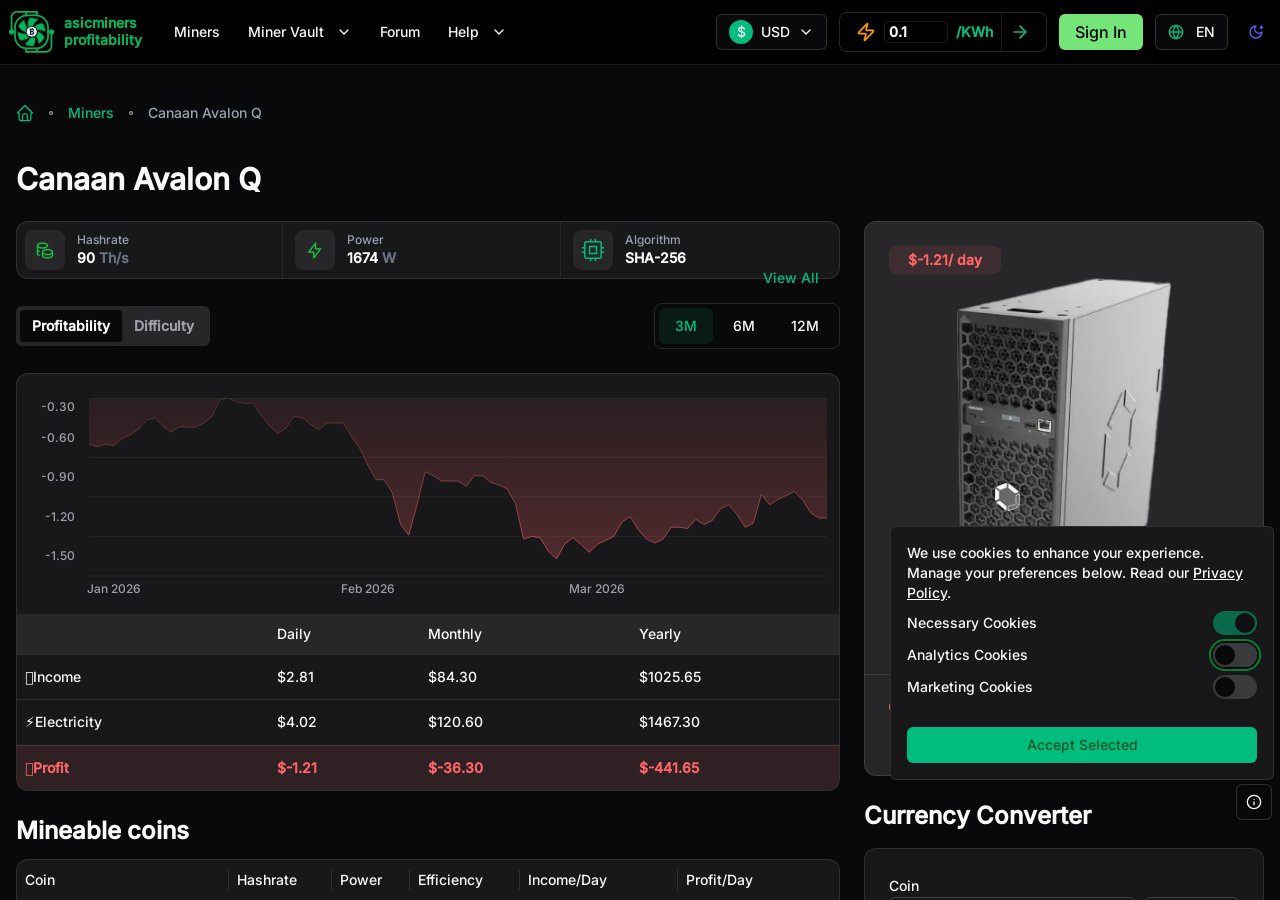
The crossover point where ASIC miner home heating stops making sense is around €0.25–0.28/kWh for lower-efficiency machines. Above that, you are subsidising the network more than it is subsidising you — unless your alternative heating costs are equally expensive. (Source: asicminersprofitability.com, Q1 2026)
Best ASIC Miners for Home Heating Right Now
Goldshell AE Box Pro — The Quiet Living Room Option
The Goldshell AE Box Pro runs at 44 MH/s on the Aleo network and draws around 200–230W. That is roughly the same as a bright floor lamp and a laptop running simultaneously. Noise levels are low enough that you can hold a conversation next to it. For a home office or bedroom, this is genuinely the most liveable option on this list — though 230W does not heat a large room on its own. Think of it as supplementary warmth, not a replacement for your central heating.
What it does well: it runs on a standard EU socket, it does not require industrial ventilation, and Aleo mining at this scale remains accessible for home participants. Worth knowing before you buy — Aleo network difficulty will evolve, and projected returns should be verified against current data before purchase.
Bitmain Antminer X9 — For XMR Miners Who Want Heat and Privacy Coins
The Bitmain Antminer X9 targets the Monero RandomX algorithm. It produces meaningful heat output while sitting in a different market segment to SHA-256 Bitcoin miners — XMR has its own risk and reward profile, and its community has historically pushed back against ASIC mining. That tension is real and worth understanding before you invest. From a heating perspective, the X9's power draw translates directly to thermal output, making it a functional space heater in any room with adequate airflow.
Pinecone INIBOX — The Mini Miner That Actually Fits Your Home
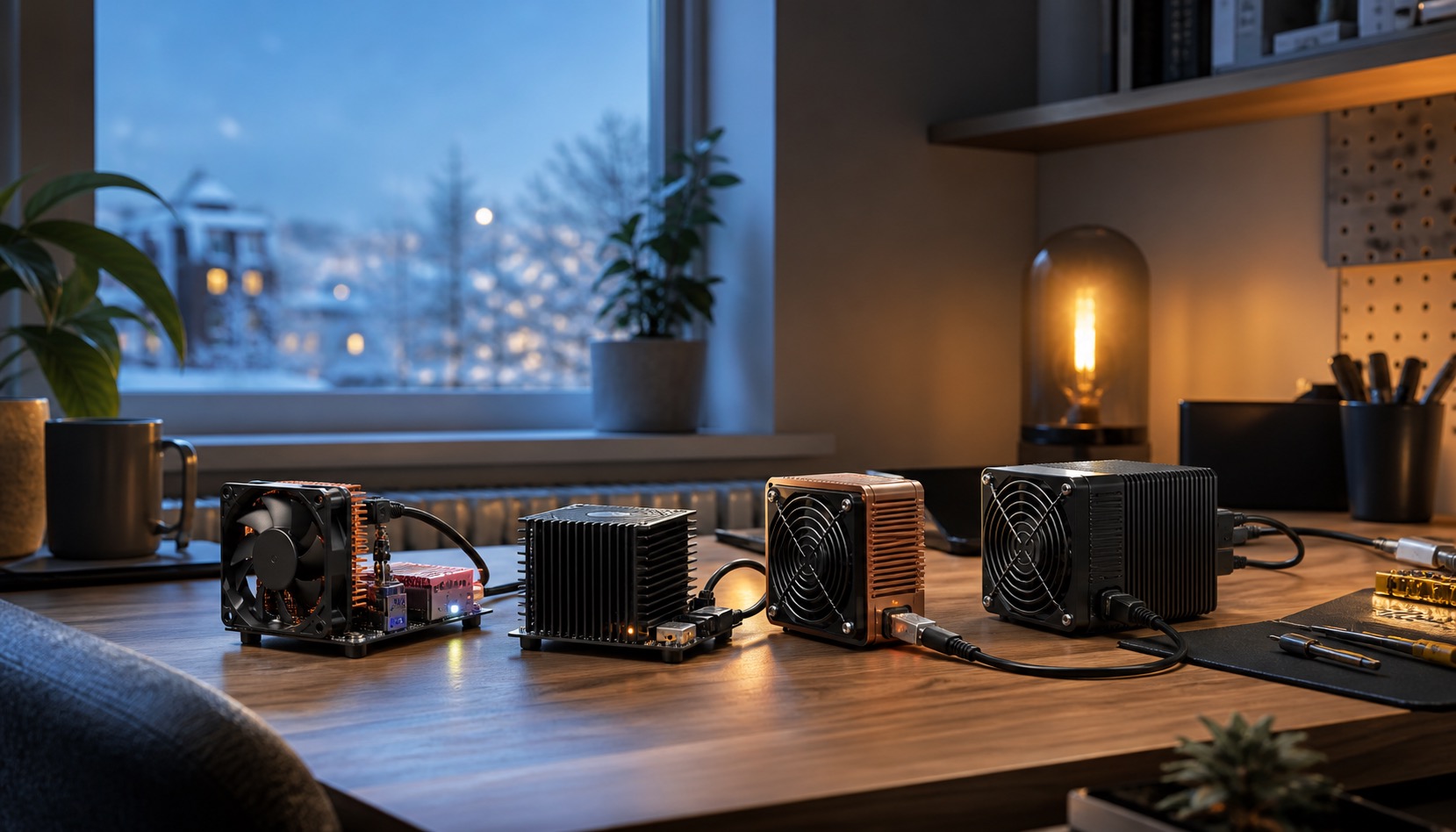
The Pinecone Matches INIBOX is a compact INI algorithm miner aimed squarely at home users who want something unobtrusive. Low power draw, desktop form factor, standard socket. It is not going to heat your entire ground floor. But placed under a desk or in a small study, it handles supplementary warmth while ticking over. The heating benefit is modest — honest about that — but the form factor is the best on this list for beginners who have never run a miner before.
Bitmain Antminer S23 Hyd — For Serious Home Setups Only
The Bitmain Antminer S23 Hyd is a different category entirely. Hydro-cooled, high-hashrate SHA-256 Bitcoin mining, and not something you plug into a kitchen socket. It requires a water cooling loop, 3-phase power in most configurations, and serious infrastructure. But for a homeowner with a garage setup or a small dedicated space — and electricity below €0.22/kWh — it produces significant heat output that can be channelled via a heat exchanger into domestic hot water or underfloor heating loops. Several Scandinavian and German customers have done exactly this. (We have seen firsthand that these hydro setups require genuine planning, but the people who do it properly end up with effectively free heating for months at a time.)
Miner Comparison Table
| Miner | Algorithm | Power Draw | Heat Output | Noise Level | Home Suitability |
|---|---|---|---|---|---|
| Goldshell AE Box Pro | Aleo | ~220W | ~220W thermal | Low (~45 dB) | ★★★★★ Best for living rooms |
| Pinecone INIBOX | INI | ~150–300W | ~150–300W thermal | Low–Medium | ★★★★☆ Great for beginners |
| Antminer X9 (XMR) | RandomX | ~1,000W | ~1,000W thermal | Medium–High | ★★★☆☆ Utility room / garage |
| Antminer S23 Hyd | SHA-256 (BTC) | ~3,000W+ | ~3,000W thermal | Low (hydro-cooled) | ★★★★☆ With proper infrastructure |
The One Thing Most People Get Wrong
Every article about ASIC miner home heating tells you to buy the most efficient machine possible. Honestly, that is not great advice for home heating specifically — and here is why.
Efficiency (measured in joules per terahash, or J/TH for Bitcoin miners) matters enormously when your goal is maximising mining profit. But when your goal is replacing heating you were going to run anyway, efficiency is almost irrelevant. A less efficient miner that produces more heat per watt of electricity is not a worse heater — it is a better one. You want the heat. The question is only whether the mining revenue justifies the machine's purchase price, not whether you are extracting every last terahash from every watt.
This flips the whole buying logic. For pure mining, buy the most efficient unit you can afford. For home heating with mining as a bonus, buy the unit whose heat output matches your room size and whose purchase price gives you a reasonable payback period — even if the efficiency numbers look worse on paper.
In our experience shipping to customers across 27 EU countries, the biggest mistake beginners make is buying an underpowered mini miner expecting it to both heat a room and generate meaningful Bitcoin revenue. Pick one primary goal. The other becomes a side benefit.
Mineshop.eu has been supplying European miners with genuine ASIC hardware since 2016; most orders ship from Ireland and Latvia, both in the EU, with fast DHL/FedEx delivery across all EU countries.
Frequently Asked Questions
Can an ASIC miner actually heat a room?
A: Yes. Every watt consumed by an ASIC miner is converted to heat — a 900W machine produces 900W of thermal output, equivalent to a medium electric panel heater. A 220W compact miner like the Goldshell AE Box Pro will take the edge off a small room (under 15 m²) but will not replace a central heating radiator in a larger space. Match the machine's wattage to your room size the same way you would choose a heater.
What electricity rate makes ASIC home heating profitable in Europe?
A: For compact home miners in 2026, the break-even electricity rate sits around €0.22–0.25/kWh when accounting for current Bitcoin prices near $66,500 USD and a network hashrate of 800–1,000 EH/s. Above €0.25/kWh, mining revenue alone rarely covers electricity on smaller machines — but if you are displacing heating costs you would have paid regardless, the effective electricity cost for mining drops significantly. (Source: asicminersprofitability.com, Q1 2026; Eurostat, Q4 2025)
How loud are home ASIC miners?
A: Compact home miners like the Goldshell AE Box Pro and Pinecone INIBOX run at approximately 40–50 dB — comparable to a quiet dishwasher or a desktop fan on low. Industrial SHA-256 miners can reach 70–80 dB, which is genuinely uncomfortable in a living space. Always check the decibel rating before buying. If the spec sheet does not list it, that is usually a warning sign.
After the April 2024 halving, is home mining still worth it?
A: The block reward dropped to 3.125 BTC in April 2024, cutting direct mining revenue per block in half. However, Bitcoin's price has since risen to approximately $66,500 USD, which partially compensates. Home mining in 2026 is viable as a heating subsidy strategy for those under €0.22/kWh, and remains interesting for hobbyists who value the self-sovereignty aspect regardless of pure profit. Expecting to get rich from a single home miner is unrealistic.
Do I need special wiring for a home ASIC miner?
A: Compact miners under 500W — including the Goldshell AE Box Pro and Pinecone INIBOX — run on standard 230V EU household sockets. Larger machines like the Antminer X9 at ~1,000W should be on a dedicated circuit to avoid tripping breakers. Hydro-cooled units like the Antminer S23 Hyd require specific electrical infrastructure and water cooling circuits — not a weekend DIY project unless you know what you are doing.
Which home ASIC miner is best for a complete beginner in Europe?
A: The Goldshell AE Box Pro or the Pinecone INIBOX are the most accessible starting points — low noise, standard sockets, desktop form factors, and manageable power draw. Neither will transform your finances, but both will give you hands-on experience with mining while contributing meaningful supplementary heat to a small room. Start small, understand the economics, then scale.
What to Do Next
If your heating bill is already painful and your electricity rate is under €0.24/kWh, replacing one electric heater with a compact ASIC miner is a genuinely rational decision in 2026. You get the same heat, you learn how mining works, and you accumulate small amounts of Bitcoin or alternative coins that you would not otherwise have. The gains are not spectacular. But the downside — paying for heat you were going to buy anyway — is the same as doing nothing.
For anyone serious about scaling this into a proper home setup with higher hashrate and heat-exchanger integration, the hydro-cooled options open up a different conversation about infrastructure costs versus long-term heating savings.
Browse the full range of home miners at Mineshop.eu, or go straight to the mini miners category if you want something that fits on a shelf and runs quietly tonight. Questions about which machine fits your specific electricity rate and room size? Contact the team directly — we have shipped to customers in every EU country and can give you a straight answer.
Comments (0)