

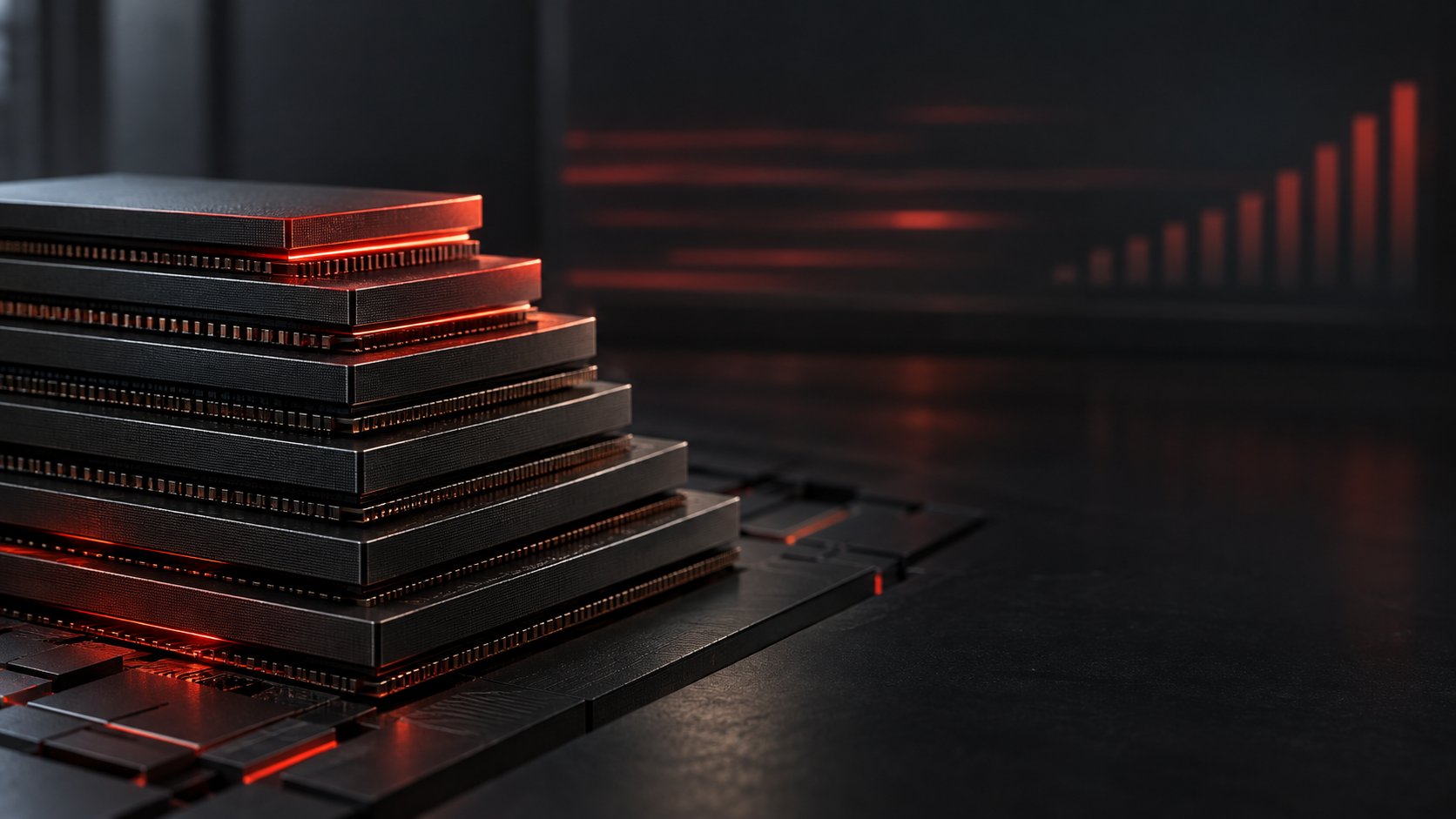
AMD Instinct MI455X: CDNA 5, 432GB HBM4 and 40 PFLOPS Explained
AMD's answer to the next generation of NVIDIA accelerators has a name and numbers: the AMD Instinct MI455X, built on the new CDNA 5 architecture. It stacks 432GB of HBM4 memory feeding over 40 PFLOPS of dense FP4 compute — a chip designed to anchor AMD's Helios rack-scale AI systems. Here is what AMD has disclosed, how it compares, and what it realistically means if you are not a hyperscaler.
AMD Instinct MI455X specifications
| Specification | Instinct MI455X (CDNA 5) |
|---|---|
| Architecture | CDNA 5, TSMC N2 (2nm GAAFET) compute dies |
| Transistors | 320 billion |
| Memory | 432GB HBM4 (36GB per stack — 1.5× the MI355X) |
| Memory bandwidth | 23.3 TB/s (2.9× the MI355X) |
| Peak AI compute | 40+ PFLOPS dense FP4 (half that for FP8) |
| Matrix performance | Up to 4× prior generation at FP4/FP8 |
| Power | Not disclosed (MI355X was already up to 1400W) |
| System context | Helios rack-scale platforms |
Every figure above comes from AMD's Instinct disclosures and the architecture deep dives that followed. Undisclosed power draw is itself a signal: at this tier, cooling and power delivery are solved at the rack level, not the card level.
Why HBM4 at 23.3 TB/s matters
The MI455X is engineered around a simple reality: flagship AI workloads are bandwidth-hungry in a way inference-only cards are not. HBM4's 36GB stacks let AMD reach 432GB while more than doubling bandwidth versus the previous generation — 23.3 TB/s is multiple times what even the fastest PCIe-attached designs offer. For giant training runs and dense serving, that bandwidth is the difference between utilization and starvation. The move to TSMC's first 2nm-class GAAFET node for the compute dies is what makes the 320-billion-transistor package deliverable at all.
Contrast this with Intel's freshly named GPU D270: 480GB of slower LPDDR5X, a fraction of the compute, one standard PCIe slot and 350W. Two coherent but opposite philosophies — capacity per watt versus bandwidth per rack — aimed at different corners of the same AI market.
CDNA 5's bigger changes
CDNA 5 is more than a node shrink. AMD has radically altered the core architecture for the tensor era, and the generational jumps line up neatly: 4× peak matrix throughput at the FP4 and FP8 precisions that dominate modern AI, roughly 2× peak for most other formats, and 2.9× memory bandwidth — all landing in one generation because compute, interconnect and memory moved together. Dense FP4 throughput of 40+ PFLOPS per package is the headline; the half-rate FP8 figure (still ~20 PFLOPS-class) is the one training customers will quote.
The physics tax is power. MI355X was already a 1400W part, and AMD has declined to publish MI455X consumption — a strong hint that the number is set by rack-level cooling contracts rather than marketing comfort. This is silicon designed to live in Helios trays with engineered power delivery, not on a desk.
MI455X versus the field at a glance
| AMD MI455X | Intel GPU D270 | Workstation RTX 6000 Pro | |
|---|---|---|---|
| Memory | 432GB HBM4 | 160–480GB LPDDR5X | professional GDDR class |
| Bandwidth | 23.3 TB/s | 1.5 TB/s | ~1.6–1.8 TB/s |
| Compute | 40+ PFLOPS FP4 | 1.3 PFLOPS FP8 | balanced pro workloads |
| Form | rack-scale (Helios) | PCIe card, 350W | buys and ships today |
What MI455X means for buyers
If you buy AI infrastructure by the rack
MI455X + Helios is AMD's most credible swing yet at NVIDIA's rack-scale dominance: CDNA 5's tensor-heavy redesign, HBM4 capacity, and a platform story that pairs AMD accelerators with EPYC and Broadcom switching. If your workloads are bandwidth-bound at scale, this generation deserves a benchmark slot in your roadmap.
Does any of this fit in a workstation?
No. MI455X is an OAM-style rack module with undisclosed (and clearly four-digit) power draw, liquid-cooled trays and an ecosystem built around Helios. Nothing about it converts to a tower under a desk — and that is by design. Workstation-class AI work belongs to professional GPUs with mature drivers and sane power envelopes.
If you need capable AI hardware at workstation scale
Nothing about MI455X changes what fits on your desk this year — and that is fine. Professional GPUs with large memory and mature software remain the practical answer for local model work, prototyping and inference. Our Mineshop AI Workstation configurations — up to triple NVIDIA RTX 6000 Pro GPUs — are specified, supported and shipping in the EU now. You can follow the Instinct family's evolution on AMD's official Instinct pages while your real workloads run on hardware you already own.
The bigger picture
With NVIDIA's Rubin generation, AMD's MI455X and Intel's capacity-first D270 all landing in the same cycle, the AI accelerator market has real three-way competition for the first time in years. Competition compresses prices at every tier — including the workstation tier where most teams actually start. Watch what AMD's partners announce for Helios availability; expect the memory-capacity headlines (432GB, 480GB and climbing) to keep redefining what "a lot of VRAM" means.
Bottom line
The Instinct MI455X is AMD's most ambitious accelerator: CDNA 5 on 2nm silicon, 432GB of HBM4 at 23.3 TB/s, and 40-PFLOP-class AI throughput for rack-scale systems. It validates the memory-first direction of the whole industry. For everyone not building a data center this quarter, the actionable move is the same as ever: matched, proven hardware in hand — see the AI workstation range — and a benchmark plan for the day MI455X-class parts reach your scale.
Related Blog
Intel GPU D270: The 480GB Crescent Island AI Accelerator Explained
Oct 13, 2026 by Mineshop Team
Mineshop
How to Build Your Own AI Workstation (vs DGX Spark)
Sep 9, 2026 by Mineshop Team
Mineshop AI Workstation