

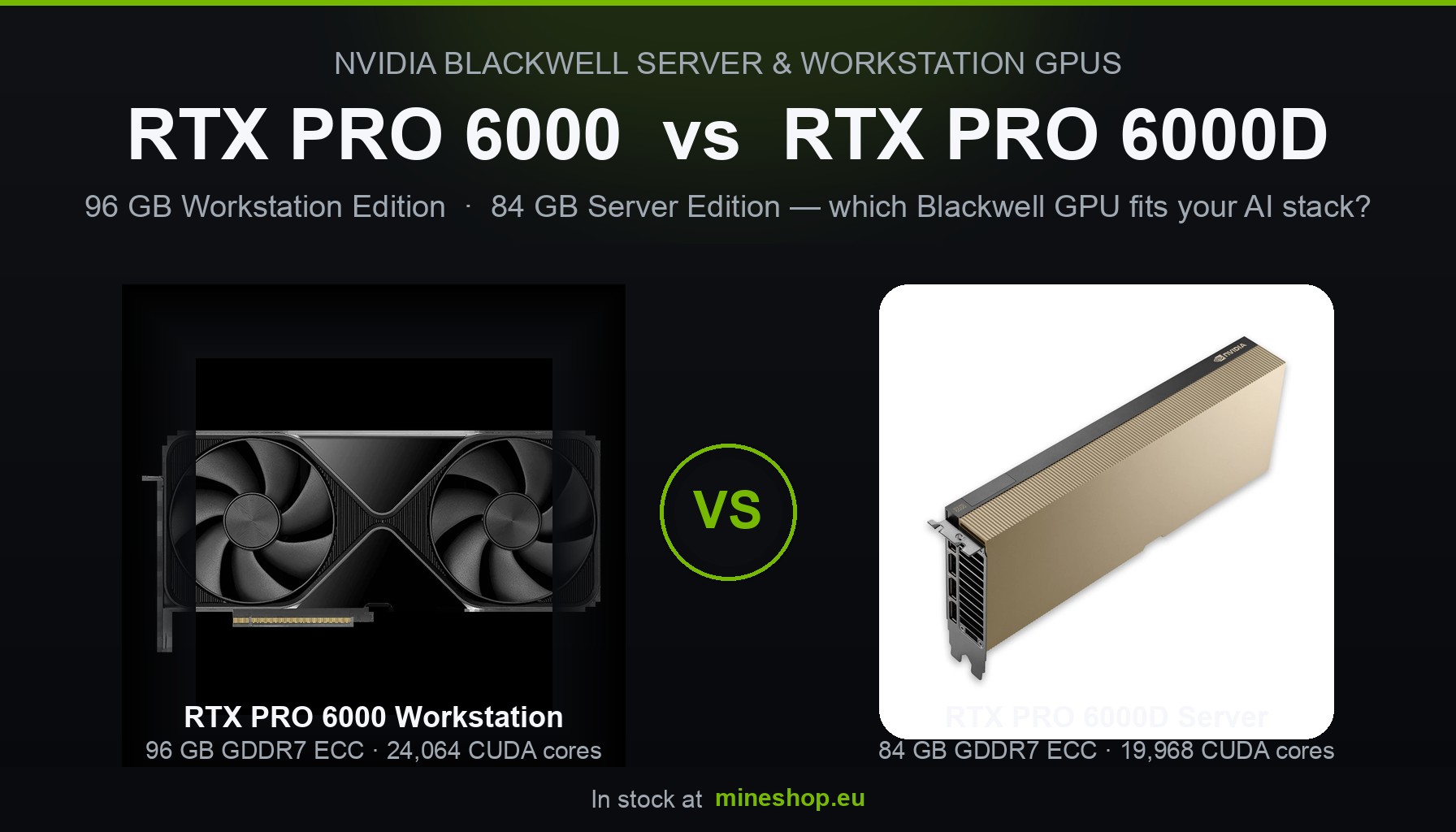
RTX PRO 6000 vs RTX PRO 6000D: Which Blackwell GPU Should You Buy in 2026?
NVIDIA's Blackwell generation has created a genuinely confusing choice for anyone building an AI workstation or a multi-GPU inference server in 2026: the RTX PRO 6000 vs RTX PRO 6000D. One is the most powerful desktop GPU NVIDIA has ever shipped; the other is a slightly cut-down variant that costs roughly €4,500 less per card and sips 200 W less power. Both are in stock at Mineshop right now — and in this guide we compare their specs, real-world AI inference performance and price so you can pick the right one for your workload.
We sell both cards, so this comparison uses NVIDIA's official specification data (as of September 2026) plus our own experience shipping Blackwell GPU servers across Europe. If you just want the short answer, skip to the verdict below.
What We Cover
- Quick verdict: which GPU wins for which job
- Full spec comparison table
- Why the RTX PRO 6000D exists
- AI & LLM inference performance
- Which one should you buy?
- Availability & pricing at Mineshop
- FAQ
Quick Verdict
If you are building a multi-GPU AI inference server, the RTX PRO 6000D Blackwell Server Edition 84GB is the smarter buy: it delivers nearly identical memory bandwidth for LLM inference, costs about €4,500 less per card, and its 400 W board power lets you fit more GPUs on the same power circuit.
If you need the absolute maximum per-slot performance — 96 GB of VRAM, all 24,064 CUDA cores and full FP4 throughput for rendering, simulation or single-GPU LLM work — the RTX PRO 6000 Blackwell Workstation Edition 96GB is still the king of desktop GPUs, and nothing else on the market replaces it.
RTX PRO 6000 vs RTX PRO 6000D: Full Spec Comparison
Both cards are built on the same NVIDIA Blackwell architecture with GDDR7 memory with error-correcting code (ECC), fifth-generation Tensor Cores and PCIe Gen 5. The differences come down to memory capacity, core count and power. Here is the full breakdown, according to NVIDIA's official specification pages and board data as of September 2026:
| Specification | RTX PRO 6000 Workstation Edition | RTX PRO 6000D Server Edition |
|---|---|---|
| NVIDIA part number | 900-5G144-2200-000 | 900-2G153-0030-000 |
| Architecture | NVIDIA Blackwell | NVIDIA Blackwell |
| GPU memory | 96 GB GDDR7 ECC | 84 GB GDDR7 ECC |
| Memory bandwidth | 1,792 GB/s | 1,568 GB/s |
| CUDA cores | 24,064 | 19,968 |
| AI performance (FP4, peak) | 4,000 TOPS | ~3,100 TOPS |
| FP32 performance | 125 TFLOPS | ~104 TFLOPS |
| Board power | 600 W | 400 W |
| Interconnect | PCIe Gen 5 x16 | PCIe Gen 5 x16 |
| Form factor | Dual-slot XHFL, active cooling | Dual-slot FHFL, passive cooling (chassis airflow) |
| Price at Mineshop | €14,299.87 | €9,799.87 |
The pattern is easy to see: the 6000D keeps the memory system almost intact (84 GB vs 96 GB, bandwidth within ~2%) but gives up about 17% of the CUDA cores and 33% of the peak FP4 compute.
Why the RTX PRO 6000D Exists
The 6000D is not a "budget" GPU — it is NVIDIA's export-compliance variant. Full-specification Blackwell data center and workstation GPUs are restricted from export to certain markets, so NVIDIA created the RTX PRO 6000D with reduced core counts specifically to satisfy those regulations for the Chinese market. It launched later than the standard card (Q3 2025) and is now reaching the European distribution channel.
That origin is good news for European buyers: the silicon, memory and driver stack are identical to the standard card. You get the same Blackwell Tensor Cores, the same GDDR7 ECC memory, and the same CUDA software ecosystem — just fewer of them, at a significantly lower price. You can read NVIDIA's official documentation for the RTX PRO 6000 family on the RTX PRO 6000 Blackwell product page and the RTX PRO 6000 Server Edition page.
AI & LLM Inference Performance
What fits in 84 GB vs 96 GB
For local LLM inference, VRAM capacity is the hard limit. In 96 GB you can run a 120-billion-parameter model in 4-bit quantization with room for a large context window. In 84 GB the same model still fits, but with less headroom for KV cache — meaning shorter context or fewer concurrent requests per card. For models in the 70B–120B class, the practical difference is real but smaller than most people expect: you trade maximum context length, not model access.
Speed: memory-bound vs compute-bound
Here is the part most comparison tables miss: LLM token generation is memory-bandwidth-bound, not compute-bound. Because the 6000D keeps 1,568 GB/s of bandwidth — within about 2% of the full card — its tokens-per-second on large quantized models is nearly identical to the RTX PRO 6000. Where the full card pulls ahead is prompt processing (compute-heavy), batched serving at high concurrency, FP8/FP4 training, fine-tuning, and non-AI workloads like rendering and simulation.
Efficiency and density
The 6000D's 400 W board power versus 600 W is a bigger deal than it looks. In a four-GPU build that is 1,600 W of GPU power instead of 2,400 W — the difference between fitting on a standard 16 A single-phase circuit and needing dedicated electrical work. Per watt, the 6000D is roughly 20% more efficient at FP4 inference workloads, which matters for 24/7 inference nodes.
Which One Should You Buy?
Buy the RTX PRO 6000D Server Edition if you:
- Run LLM inference (vLLM, llama.cpp, SGLang) as a service or internal tool
- Want the best €-per-GB-of-VRAM ratio (~€117/GB vs ~€149/GB)
- Are limited by rack or office power delivery
- Plan multi-GPU scaling where PCIe Gen 5 and GPU count matter more than per-slot peak
Buy the RTX PRO 6000 Workstation Edition if you:
- Need maximum context length and batch size on a single card
- Do rendering, simulation, CFD or video work alongside AI
- Fine-tune or train models where FP8/FP4 compute throughput is the bottleneck
- Want the no-compromise flagship in a single-GPU workstation
Availability & Pricing at Mineshop
Both cards are in stock and shipping from our EU warehouse with VAT invoice and warranty:
- NVIDIA RTX PRO 6000 Blackwell Workstation Edition 96GB — part number 900-5G144-2200-000 — €14,299.87
- NVIDIA RTX PRO 6000D Blackwell Server Edition 84GB GDDR7 ECC — part number 900-2G153-0030-000 — €9,799.87
We also build ready-to-run GPU systems around these cards — if you need a complete single- or dual-GPU AI workstation instead of a bare card, our team can configure it for your workload.
FAQ
Is the RTX PRO 6000D slower than the RTX PRO 6000?
In compute-heavy workloads, yes: it has ~17% fewer CUDA cores and roughly 22% lower peak FP4 throughput. But in memory-bandwidth-bound LLM inference, token generation speed is within about 2% of the full card because both share nearly identical memory bandwidth.
How much VRAM do I actually need — 84 GB or 96 GB?
Both run 70B-class models at high quality and 120B-class models in 4-bit quantization. 96 GB buys extra KV-cache headroom — longer context windows and more concurrent users per card. If you serve many simultaneous requests, that headroom is worth the premium.
Can I mix RTX PRO 6000 and 6000D cards in one server?
Yes — they use the same Blackwell driver stack and CUDA ecosystem. For sharded inference across GPUs, matching memory capacity across cards keeps scheduling simple, so a uniform pool of 6000D cards is usually the cleaner choice.
Is it legal to buy the RTX PRO 6000D in Europe?
Yes. The 6000D is a China-market export variant, but it is fully legal to purchase and own in the EU. It ships through standard international distribution with full warranty.
Do these cards support NVLink?
No. Both the RTX PRO 6000 and 6000D are PCIe Gen 5 only — multi-GPU communication runs over PCIe. For tensor-parallel serving of very large models, PCIe Gen 5 provides enough bandwidth for most inference workloads.
What power supply do I need?
Plan for 600 W per RTX PRO 6000 and 400 W per 6000D, plus CPU and system overhead. A single-GPU 6000 workstation needs a quality 1,200 W PSU; a four-GPU 6000D server needs careful power-distribution planning.
Ready to Order?
Both the RTX PRO 6000 Workstation Edition and the RTX PRO 6000D Server Edition are in stock at mineshop.eu with fast EU shipping, VAT invoices and business warranty. Questions about multi-GPU builds or which card fits your models? Contact our team — we run this hardware ourselves.
Related Blog
AMD Instinct MI455X: CDNA 5, 432GB HBM4 and 40 PFLOPS Explained
Oct 13, 2026 by Guntis Vitolins
Mineshop
Intel GPU D270: The 480GB Crescent Island AI Accelerator Explained
Oct 13, 2026 by Guntis Vitolins
Mineshop