



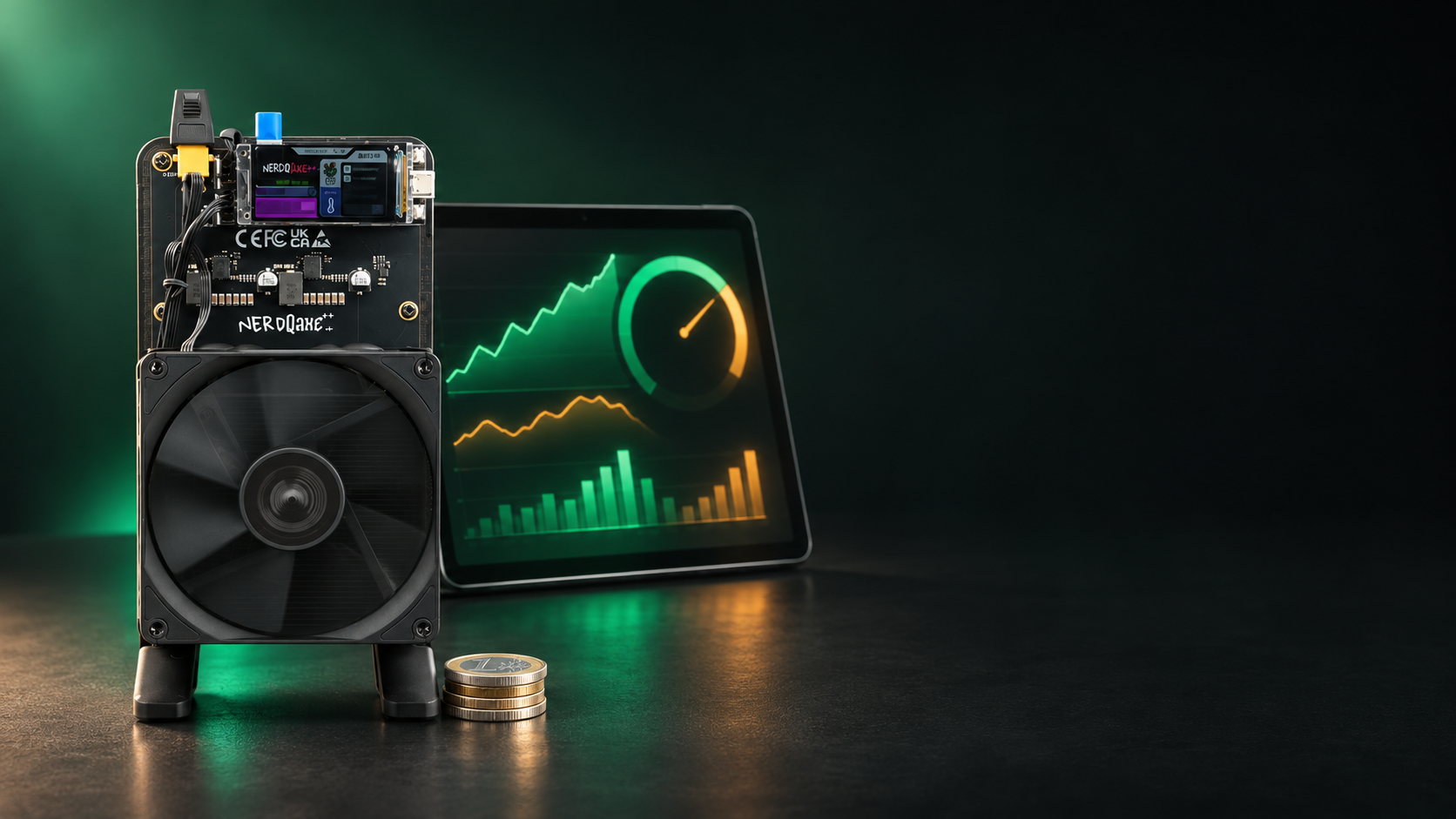
Something unusual is happening on the Bitcoin network this week: difficulty is about to drop by roughly 8%. After months of relentless increases, miners are switching off faster than new machines arrive, and the next adjustment — due within days — is tracking toward -8.3%. For home miners, that means each terahash earns slightly more tomorrow than it does today. So with Bitcoin at €62,151 and the network at 926 EH/s (checked 13 November 2026), what is actually profitable to mine right now? We ran the numbers on the hardware we sell — and the honest answer will surprise nobody who pays an electricity bill.
The November 2026 snapshot
| Metric | Value (13 Nov 2026) |
|---|---|
| Bitcoin price | €62,151 ($68,735) |
| Network hashrate | ~926 EH/s |
| Difficulty | 148.4 trillion |
| Next difficulty change | ≈ -8.3% (tracking) |
| Block reward | 3.125 BTC per block, ~144 blocks/day |
| Hashprice (revenue per TH/day) | ≈ €0.030 |
Hashprice — how much one terahash per second earns per day — is the single number that determines whether mining pays. Today it sits at roughly three euro cents per terahash per day. The calculation: 450 BTC mined daily across the network (3.125 × ~144 blocks), divided by ~926 million TH/s of total hashrate, times the current price. When difficulty drops at the next retarget, the same hardware earns ~8% more.
Honest economics: what each home miner actually earns
Here is the part most YouTube videos skip: the revenue AND the electricity cost side by side. We use each miner's manufacturer-rated specs and our €0.25/kWh reference tariff. Your wall measurements and tariff will differ — measure both.
| Miner | Hashrate | Power | Revenue/day | Electricity/day | Net/day |
|---|---|---|---|---|---|
| NerdQaxe++ Rev6.1 | 6 TH/s | 35 W | €0.18 | €0.21 | -€0.03 |
| Bitaxe Gamma | 1.2 TH/s | 15 W | €0.04 | €0.09 | -€0.05 |
| Hammer Thor P2 | 10 TH/s | 130 W | €0.30 | €0.78 | -€0.48 |
| Avalon Nano 3S | 6 TH/s | 140 W | €0.18 | €0.84 | -€0.66 |
Calculated 13 November 2026 at €62,151/BTC, ~926 EH/s network hashrate, €0.25/kWh electricity. Manufacturer-rated specs; actual wall power varies. Revenue assumes pool mining; solo mining is a lottery with the same expected value but extreme variance.
The standout: NerdQaxe++ is nearly free to run
At just 35 watts, the NerdQaxe++ Rev6.1 generates 6 TH/s — the same hashrate class as the Avalon Nano 3S at a quarter of the power. Its daily electricity cost of €0.21 nearly matches its €0.18 mining revenue, putting it within three cents per day of break-even. No other home miner in our range comes close. If your tariff is below €0.22/kWh, the NerdQaxe++ may already be profitable on pure mining revenue.
Why is difficulty dropping?
A -8.3% difficulty adjustment is rare and significant. It means a meaningful amount of hashrate went offline during the current epoch. The most common reasons: older industrial hardware becoming unprofitable at current prices, miners delaying new deployments, or large operators relocating. For home miners, the effect is simple: less competition means your existing hardware earns more. The last time difficulty dropped meaningfully, it recovered within weeks to months — the drop is a window, not a permanent shift.
The honest answer: it depends on your electricity
Here is the formula that decides everything:
Profit = (your TH/s × €0.030) - (your watts ÷ 1000 × 24 × your €/kWh)
At €0.25/kWh, every miner in our range costs more in electricity than it earns in Bitcoin. At €0.15/kWh — night-rate tariffs, solar surplus, or countries with cheaper power — the NerdQaxe++ flips to positive and the Bitaxe Gamma approaches break-even. At €0.35/kWh, nothing home-scale is profitable on mining alone. Your tariff is the single biggest variable — bigger than which miner you choose.
So why does anyone mine at home?
Because pure electricity math is not why most people buy these machines. The real value propositions:
The lottery ticket
Solo mining a block pays 3.125 BTC — about €194,000 at today's price. A 10 TH/s miner has a tiny daily chance, but it is not zero, and the odds just improved by 8%. Every two days of difficulty-adjusted mining is a fresh ticket. Nobody finances a car on this — but plenty of people happily run a €0.03/day lottery machine. Our solo mining calculator shows your actual odds.
The heat
A 140 W Avalon Nano 3S is also a 140 W space heater. If you would run an electric heater anyway in winter, the Bitcoin it mines is effectively free — the electricity does double duty. Our electricity cost guide covers this trade in detail.
Learning by doing
Understanding mining, pools, firmware and the economics of securing the Bitcoin network is genuinely valuable knowledge. A Bitaxe Gamma at -€0.05/day is one of the cheapest hands-on Bitcoin educations available.
What about other coins?
The hardware we sell is SHA-256 only — it mines Bitcoin and Bitcoin-adjacent SHA-256 coins. Scrypt, Equihash and other algorithms require different hardware. Within SHA-256, Bitcoin is effectively the only coin worth mining: SHA-256 merge-mined coins add negligible revenue. If you are asking "what is the most profitable coin to mine?", the practical answer for home miners is Bitcoin — the coin with the deepest liquidity, the most predictable economics, and the hardware ecosystem to match.
The takeaway
On 13 November 2026, with Bitcoin at €62,151 and difficulty about to drop 8%, home Bitcoin mining at typical EU electricity rates is close to break-even but not profitable on pure mining revenue. The NerdQaxe++ Rev6.1 comes within three cents per day. Cheaper electricity flips it positive. And the real reasons people mine — the lottery, the heat, the learning — do not show up in the revenue column. Run your own numbers with today's data, your tariff, and your goals. If the math works for you, browse the full home miner range and start with the machine that matches your electricity reality.
Comments (0)