



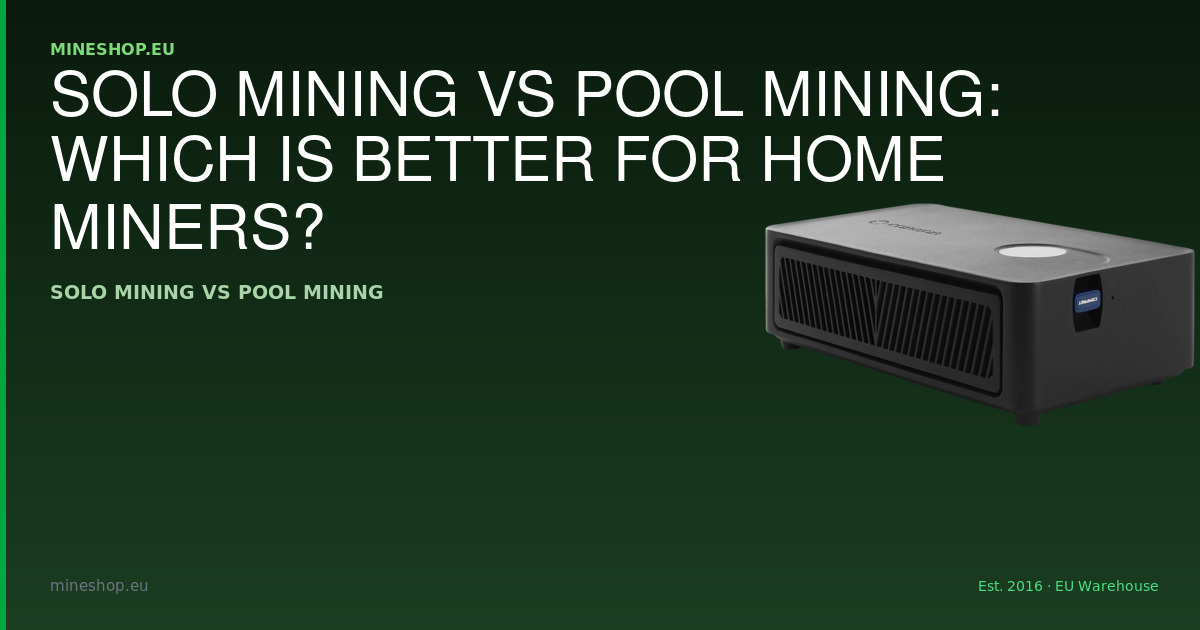
Most home miners face the same dilemma: go solo and chase the full 3.125 BTC block reward, or join a pool and collect steady, predictable payouts? The answer depends on your hardware, electricity cost, and risk tolerance. This guide breaks it down with real numbers and real machines you can buy today.
What Is Solo Mining?
Solo mining means your ASIC competes directly against the entire Bitcoin network — currently running at 800–1,000 EH/s — to find the next block. If you find one, you keep the entire 3.125 BTC reward (plus transaction fees, typically 0.1–0.3 BTC extra). If you don't, you earn nothing. It's a lottery: statistically rewarding over millions of blocks, but practically unreliable for a single home miner.
Solo mining makes the most sense for miners running low-power, low-cost machines who want to participate in Bitcoin without relying on pools. The NerdQaxe++ (4.8 TH/s, ~35W) is the classic solo mining home device — cheap to run, silent, and purpose-built for solo via CKPool or public-pool.io.
What Is Pool Mining?
Pool mining combines the hashrate of thousands of miners. When the pool finds a block, rewards are split proportionally based on your contributed shares. You get paid regularly — often daily — and variance is smoothed out. Most pools charge a 1–2% fee (FPPS or PPS+ models).
Pool mining is the standard for any miner running a serious ASIC. The Bitmain Antminer S21 Pro, Antminer S21 XP Hyd (473 TH/s), and MicroBT Whatsminer M56S (212 TH/s) are all pool-optimised machines built for 24/7 production mining.
Real Machines, Real Numbers
| Miner | Hashrate | Power | Best Use |
|---|---|---|---|
| NerdQaxe++ | 4.8 TH/s | ~35W | Solo mining, desk/shelf |
| Avalon Nano 3S | 6 TH/s | 140W | Solo or pool, home heater |
| Antminer S21 Pro | 234 TH/s | 3,510W | Pool mining |
| Antminer S21 XP Hyd | 473 TH/s | 5,676W | Pool mining, hydro-cooled |
| Whatsminer M56S | 212 TH/s | 5,724W | Pool mining |
Solo Mining: Pros and Cons
Pros
- Full block reward if you find a block (3.125 BTC + fees)
- No pool fees
- Privacy — no pool operator sees your hashrate
- Low-power machines (NerdQaxe++, Avalon Nano 3S) are viable and cheap to run
Cons
- Extremely high variance — could run for years without a reward
- Not suitable for large ASICs at European electricity prices (€0.20–0.30/kWh)
- No predictable income
Pool Mining: Pros and Cons
Pros
- Regular, predictable payouts (daily or per threshold)
- Scales well — every TH/s earns proportionally
- Compatible with all standard ASICs
- Low risk of extended zero-income periods
Cons
- 1–2% pool fee on all earnings
- Pool operator knows your hashrate and wallet address
- Contributes to pool centralisation risk
Which Should You Choose?
If you're running a low-wattage home device like the NerdQaxe++ or Avalon Nano 3S, solo mining is a legitimate choice — your electricity costs are low, and the "lottery ticket" approach is part of the fun. Track your luck at soloblocks.io.
If you're running a full-size ASIC — Antminer S21 Pro, Whatsminer M56S, or similar — pool mining is the rational choice. At €0.20–0.30/kWh, you need consistent income to cover operating costs and turn a profit.
Frequently Asked Questions
Can I switch between solo and pool mining?
Yes. Most mining firmware (Braiins OS, stock Bitmain firmware) lets you change pool settings at any time. You can point your miner at CKPool for solo, or switch to Antpool, ViaBTC, or F2Pool for pool mining — no hardware change needed.
What pool should European home miners use?
ViaBTC and F2Pool both support EU servers with low latency. For solo, CKPool and public-pool.io are the most popular choices among European home miners.
Is solo mining worth it at current difficulty?
At 800–1,000 EH/s network hashrate, a single NerdQaxe++ (4.8 TH/s) has roughly a 1-in-200,000,000 chance per block. It's a lottery — but it costs almost nothing to play. A full-size S21 Pro solo mining would statistically find a block every 2–3 years, but variance means you could wait a decade or hit one next week.
What is the best miner for pool mining?
For home miners in Europe, the Antminer S21 Pro (234 TH/s, 15 J/TH) offers the best balance of efficiency and hashrate for air-cooled setups. For larger operations with water cooling, the S21 XP Hyd (473 TH/s) is the current flagship.
The Bottom Line
Solo vs pool mining isn't a binary choice — it depends on your machine and goals. Run a mini miner? Go solo and enjoy the lottery. Run a full ASIC? Pool mining pays the bills. Either way, Mineshop.eu ships verified hardware across all 27 EU countries from our warehouse in Latvia, with DHL and FedEx delivery in 2–5 business days.
Browse our full range: home miners for solo setups, or all ASICs for pool-ready machines.
Comments (0)