



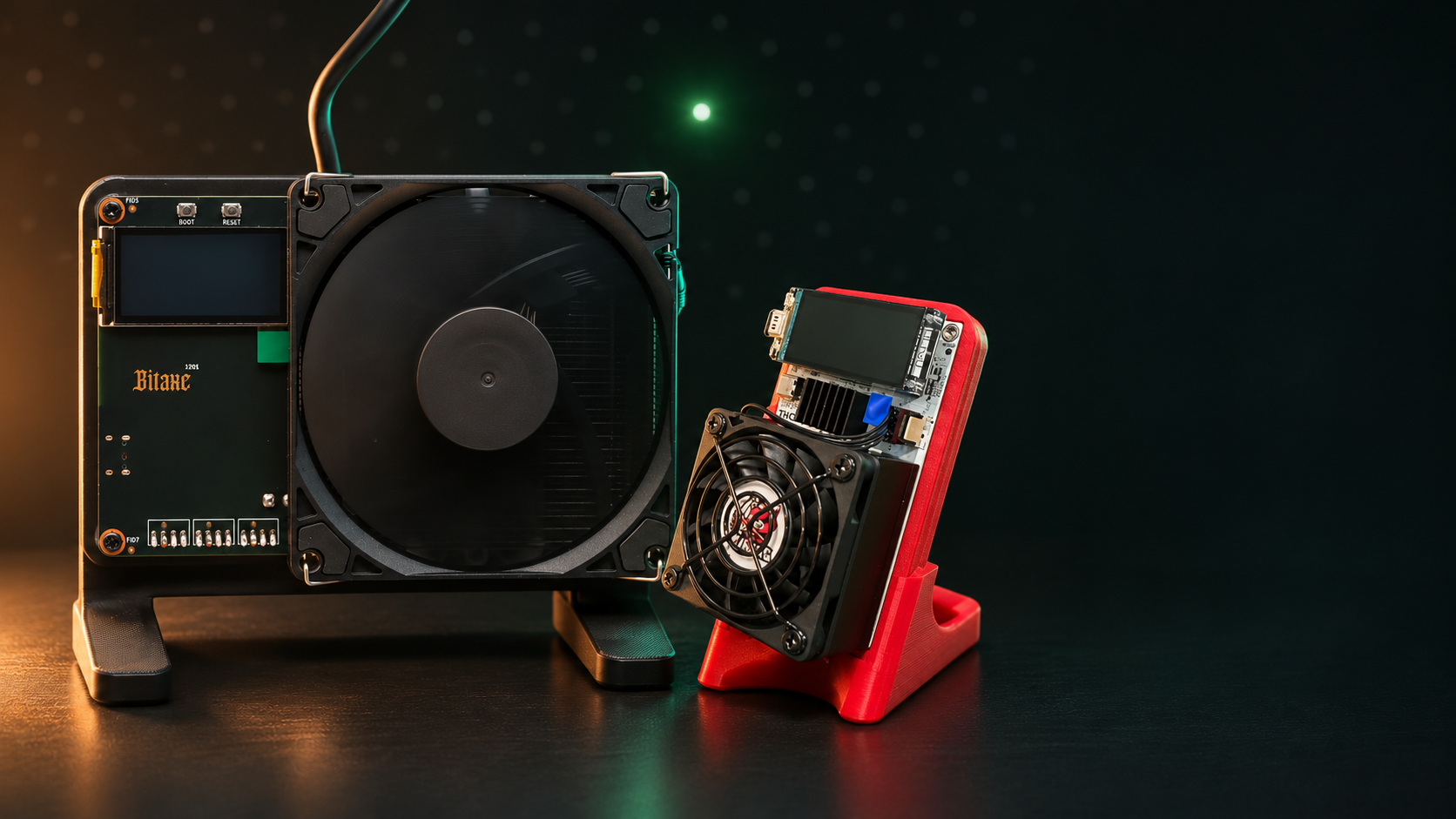
Heading into 2027, the home Bitcoin miner to buy depends less on the chip than most reviews suggest. The newest machines on Bitmain’s BM1373 ASIC are at Mineshop: the Hammer Thor X1, the Nexus S1 and the Hammer Thor P2, with two more open for pre-order, the Bitaxe Naja Duo and the Nexus S1-2. They sit alongside established BM1370 machines such as the NerdQaxe Rev7, the PowerMining NerdQaxe++ Rev6.1 and the Bitaxe Gamma 601. On paper the newer chip should win on efficiency per terahash. The best BM1373 units do, by a clear margin; others do not. This guide compares all eight on real listing figures, then answers the question most reviews skip: what are your odds of finding a solo block, on Bitcoin or on Bitcoin Cash?
The 2026–27 home miners on BM1373 and BM1370
| Miner | Chip | Hashrate | Power | J/TH | Price |
|---|---|---|---|---|---|
| Bitaxe Gamma 601 | BM1370 | 1.5 TH/s | 22 W | 14.7 | €76.29 |
| Hammer Thor X1 | BM1373 | 3.1 TH/s | 38 W | 12.3 | €179.87 |
| Nexus S1 | BM1373 | 5 TH/s | 75 W | 15.0 | €239.87 |
| NerdQaxe Rev7 | BM1370 | 6 TH/s | 100 W | 16.7 | €204.87 |
| PowerMining NerdQaxe++ Rev6.1 | BM1370 | 6.1 TH/s | 80 W | 12.5–13.1 | €329.87 |
| Bitaxe Naja Duo (pre-order) | BM1373 | 4.4 TH/s (up to 8.8 overclocked) | 42 W (about 103 W) | 9.5 (11.7) | €349.87 |
| Hammer Thor P2 (out of stock) | BM1373 | 10 TH/s | 120 W | 12.0 | €359.87 |
| Nexus S1-2 (pre-order) | BM1373 | 10 TH/s | 145 W | 14.5 | €369.87 |
Rated figures from each Mineshop listing, checked 24 November 2026; actual wall power varies. J/TH is watts divided by terahash: lower is more efficient. The Thor X1 listing shows both 11.5 and 12.3 J/TH; 38 W at 3.1 TH/s works out to 12.3, which is the figure used here. The PowerMining NerdQaxe++ Rev6.1 is listed at about 76–80 W, so its J/TH is shown as a range. The same listing also states an efficiency of about 15–16.7 J/TH, which does not follow from its hashrate and power, so treat that row’s efficiency as uncertain. The Naja Duo figures are for its overclocked mode, with its default mode in brackets.
What the newer chip actually changes
Compare like with like and one pattern stands out. The Bitaxe Naja Duo is rated at 11.7 J/TH overclocked, the Hammer Thor P2 at 12.0 J/TH and the Hammer Thor X1 at 12.3 J/TH. The NerdQaxe Rev7, on the older BM1370 chip, is rated at 16.7 J/TH. That is about 28% less electricity per terahash for the Thor P2 than for the Rev7.
It is not a clean sweep for the new chip, and this is where marketing tables mislead. The Nexus S1 uses the same BM1373 chip as the Thor X1, but at 75 W for 5 TH/s it is rated at 15.0 J/TH, about 22% more power per terahash. The Nexus S1-2 matches the Thor P2’s 10 TH/s at 14.5 J/TH against 12.0. A chip generation sets the ceiling; the board, cooling and power design around it decide where a finished miner actually lands. Judge the unit, not the chip.
Our Thor X1 vs P2 guide covers that pair in depth. It uses Hammer’s published overclock figures (up to 3.2 TH/s at 38.4 W, with power quoted for the ASIC only), while this article uses the shop listing’s 3.1 TH/s at 38 W.
Efficiency is not the same as cost per day
J/TH tells you which miner uses less power for the same hashrate. It does not tell you what a machine costs to run. The Hammer Thor P2 is among the most efficient here and still draws 120 W; the Bitaxe Gamma 601 is less efficient per terahash but draws only 22 W. At a reference tariff of €0.25/kWh, the Thor P2 costs about €0.72 a day in electricity and the Bitaxe about €0.13. Which one suits you depends on whether you are short of wall power, socket space or budget, not on which has the newer number.
Is any of it profitable? Not at €0.25/kWh
At today’s prices and network difficulty, the whole network earns about €0.023 per terahash per day on Bitcoin and about €0.025 on Bitcoin Cash. The Thor P2 therefore earns roughly €0.23 a day in expected pool revenue on Bitcoin while spending €0.72 on electricity. Every miner in the table loses money on mining revenue alone at this tariff, whatever chip it uses. We set out the full working, model by model, in our November profitability snapshot.
So why solo mine? Because the prize is different
Pool mining pays small, steady amounts. Solo mining pays nothing until your miner finds a block, and then it pays the whole reward. On Bitcoin that is 3.125 BTC plus fees, about €171,272 today. The odds are the part that matters, so here they are for each miner on both networks:
| Miner | Bitcoin: average wait | Bitcoin: chance in a year | Bitcoin Cash: average wait | Bitcoin Cash: chance in a year |
|---|---|---|---|---|
| Bitaxe Gamma 601 | avg 13,315 years | <0.01% | avg 40.9 years | 2.4% |
| Hammer Thor X1 | avg 6,443 years | 0.02% | avg 19.8 years | 4.9% |
| Nexus S1 | avg 3,994 years | 0.03% | avg 12.3 years | 7.8% |
| NerdQaxe Rev7 | avg 3,329 years | 0.03% | avg 10.2 years | 9.3% |
| PowerMining NerdQaxe++ Rev6.1 | avg 3,274 years | 0.03% | avg 10.1 years | 9.5% |
| Bitaxe Naja Duo (8.8 TH/s) | avg 2,270 years | 0.04% | avg 7.0 years | 13.4% |
| Hammer Thor P2 | avg 1,997 years | 0.05% | avg 6.1 years | 15.0% |
| Nexus S1-2 | avg 1,997 years | 0.05% | avg 6.1 years | 15.0% |
Estimated from rated hashrate against network hashrate on 24 November 2026 (Bitcoin about 1,050 EH/s, Bitcoin Cash about 3.23 EH/s), assuming roughly 144 blocks a day on each. “Chance in a year” is the probability of at least one block in 365 days, running non-stop. The Naja Duo row uses its overclocked hashrate. Averages hide the spread: most miners get nothing in that year, a few get a block.
Read the Bitcoin column first. Even the Hammer Thor P2 and Nexus S1-2 average about 1,997 years per block and have a 0.05% chance of finding one in a year of continuous running. For a home miner, solo Bitcoin is a very long-odds lottery. Now the Bitcoin Cash column. The same 10 TH/s averages about 6.1 years per block and has roughly a 15% chance of at least one block in a year. The Hammer Thor X1 is near 5%, the Bitaxe Naja Duo about 13% overclocked and the Bitaxe Gamma 601 about 2.4%.
In expected value the two networks are close today, slightly higher on Bitcoin Cash. The choice between them is about the size of the prize and how long you are willing to wait. A BCH block is worth 3.125 BCH, about €568, against roughly €171,000 for a Bitcoin block. Those are real odds, and they are still long odds: you are choosing between a tiny chance of a large reward and a small chance of a modest one.
Three ways to use the same hashrate
Run your own miner
Buy a unit from the table, point it at a pool and run it. You pay for the hardware and the electricity, and the hashrate is yours for the life of the machine. Start with the home miner range if you do not own one yet.
Point it at Bitcoin Cash
The same SHA-256 hardware mines BCH. Our Bitcoin Cash solo pool needs no account: use your BCH address as the username. It has two modes. Solo pays 100% of a block to the finder. The Podium splits each block three ways: 70% to the finder and 20% and 10% to the two other wallets with the best shares of that round, with a 0% pool fee. On the Podium the finder’s share of a block is about €397 today instead of €568, in exchange for two extra paying places per block. Your chance of being the finder is the same in both modes. Your chance of a place prize depends on who else is mining, which we cannot estimate for you. The pool’s block list shows three BCH blocks found in the week to 24 November 2026. The most recent was found by a rental of about 3 PH/s running for nine hours, roughly 300,000 times the hashrate of a 10 TH/s home miner. Our BCH solo mining guide covers the setup in full.
Rent hashrate instead
If you want more tickets without buying hardware, HashStrike, Mineshop’s hashrate rental service, rents SHA-256 hashrate by the hour or by the day and points it at your own address. It lists small-miner sizes from 1.2 TH/s as well as large rentals, and supports both Bitcoin and BCH. Renting does not change the odds per terahash; it lets you run more terahash for a short time. The price is worth being clear about. On 24 November 2026, a day of 10 TH/s was listed at 1,119 sats, about €0.61, while 10 TH/s had an expected mining revenue of roughly €0.23 on Bitcoin or €0.25 on BCH. The rental cost about two and a half times what the same hashrate earns in expectation, so a rental only pays if it finds a block. Treat it as buying lottery tickets, not as an investment.
The two pre-orders: Naja Duo and Nexus S1-2
Both new machines are listed for pre-order, with the first batch expected in December 2026. That date is an estimate and can move with production and transport.
Bitaxe Naja Duo: the most efficient machine in this comparison
The Bitaxe Naja Duo runs two BM1373 chips and has two modes. In default mode it is listed at 4.4 TH/s and about 42 W, which works out to about 9.5 J/TH. Overclocked it reaches up to 8.8 TH/s at about 103 W, or about 11.7 J/TH. Either figure beats every other unit in the table. At the overclocked rate it has roughly a 13% chance of finding a BCH block in a year of continuous solo mining, and about 7% in default mode. On Bitcoin the chance is 0.04% overclocked. At €349.87 it costs less than the Hammer Thor P2 and the Nexus S1-2, and its default mode costs about €0.25 a day in electricity at the reference tariff.
Nexus S1-2: the same hashrate as the Thor P2, more power
The Nexus S1-2 is listed at 10 TH/s and about 145 W, or about 14.5 J/TH. That matches the Hammer Thor P2’s hashrate with 25 W more power, about 21% more electricity per terahash, so its block odds are the same as the Thor P2’s.
What we would actually buy
For most home miners the decision comes down to watts available and budget. The Hammer Thor X1 is the most efficient unit in stock: about 38 W for 3.1 TH/s at €179.87. The Bitaxe Naja Duo is the one to watch, the most efficient machine in this comparison in either mode, available for pre-order. The Hammer Thor P2 offers 10 TH/s at 12.0 J/TH but was out of stock on 24 November; the Nexus S1-2 matches its hashrate at a higher power draw. The Nexus S1 sits in the middle on price and gives 5 TH/s, using more power per terahash than the Thor X1 despite the same chip. Among the BM1370 machines, the NerdQaxe Rev7 lists 6 TH/s at 100 W and the PowerMining NerdQaxe++ Rev6.1 6.1 TH/s at about 76–80 W, though the Rev6.1 listing’s efficiency figures do not agree with each other. And the Bitaxe Gamma 601 is the cheapest and least power-hungry of the eight compared here.
Whichever you choose, run your own numbers first. Our solo mining calculator shows block odds for your hashrate and timeframe, and SoloBlocks.io shows solo blocks as they are found. For choosing a Bitcoin pool, see our solo mining pools guide.
Comments (0)